
AI in Ayurveda: Real-World Applications and Future Potential

Updated: Aug 9

Ayurveda has always emphasized personalized care, deep observation, and long-term outcomes. Today, with the rise of Artificial Intelligence (AI), Ayurveda is entering a new phase—where traditional wisdom meets modern technology.
AI in Ayurveda is no longer a distant concept. With the right clinical data foundation, platforms like AyurCDS are enabling real-world AI applications that enhance diagnosis, treatment planning, and patient outcomes—without compromising Ayurvedic principles.
Understanding AI in the Context of Ayurveda
Artificial Intelligence (AI) refers to systems that can analyze large amounts of data, identify patterns, and assist in decision-making.
In Ayurveda, AI does not replace the Vaidya. Instead, it acts as a clinical intelligence layer that supports practitioners by learning from real patient data collected over time.
AI in Ayurveda focuses on:
Pattern recognition across Prakriti and Vikriti profiles
Treatment outcome analysis
Clinical decision support
Long-term disease progression tracking
This becomes possible only when Ayurvedic data is digitized and structured, which is where AyurCDS plays a critical role.
Why Ayurveda Is Naturally Suited for AI
Ayurveda is inherently data-rich:
Detailed patient histories
Multi-dimensional diagnosis (Dosha, Agni, Ama, Dhatu)
Long-term treatment timelines
Lifestyle and dietary variables
Real-World Applications of AI in Ayurveda
1. AI-Assisted Diagnosis Support
By analyzing thousands of similar cases, AI systems can:
Highlight possible Dosha imbalances
Suggest commonly associated conditions
Support early detection of chronic disorders
2. Diagnosis from Tongue images
By analyzing tongue color, coating thickness, moisture, texture, fissures, and shape through image recognition and pattern analysis, AI can assist practitioners in identifying subtle variations linked to Kapha, Pitta, and Vata imbalances. When integrated thoughtfully, AI does not replace the Vaidya’s clinical judgment but augments Yukti (clinical reasoning) by converting visual observations into structured data. This enables longitudinal tracking, inter-practitioner consistency, and real-world evidence generation—helping transform Jihwa Pariksha from a subjective art into a scalable, evidence-supporting diagnostic component of modern Ayurveda practice.
3. Digital Nadi Pulse Diagnosis
Traditionally, Nadi Pariksha relies on the Vaidya’s tactile sensitivity and experiential knowledge to assess Dosha dominance, Agni status, and systemic imbalances through pulse characteristics such as gati (movement), bala (strength), tala (rhythm), and sthiratva (stability). With the support of AI-enabled sensors and signal analysis, pulse waveforms can now be captured digitally and analyzed for patterns, variations, and correlations over time. AI helps transform these complex pulse signals into structured, repeatable data, supporting consistency, longitudinal monitoring, and clinical documentation. Importantly, digital Nadi Pariksha is not intended to replace the practitioner’s expertise; instead, it enhances Yukti and Anubhava by providing objective insights that complement traditional interpretation, paving the way for evidence-based Ayurveda while preserving the essence of classical diagnostic wisdom.
4. Personalized Treatment Recommendations
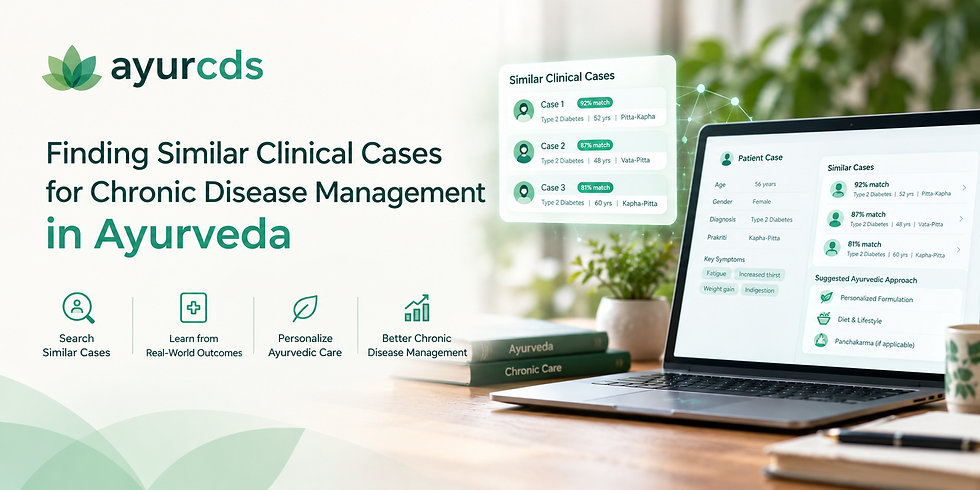
By analyzing structured clinical data—such as Prakriti, Vikriti, Dosha involvement, Agni status, disease stage, lifestyle factors, and documented outcomes from similar cases—AI can assist in suggesting treatment pathways, therapeutic priorities, and follow-up considerations aligned with Ayurvedic logic. Rather than replacing the Vaidya’s judgment, AI functions as a clinical support layer, helping practitioners recognize patterns, avoid omissions, and refine Yukti (rational application of knowledge). When grounded in real-world practice data, AI recommendations enhance treatment consistency, improve documentation, and enable longitudinal learning, thereby strengthening evidence-based Ayurveda while respecting the individualized and holistic nature of Ayurvedic treatment.
AyurCDS provides the historical treatment data needed to power such AI-driven personalization.
5. Treatment Outcome Prediction
One of the strongest future applications of AI in Ayurveda is predicting:
Likely response to therapies
Time required for improvement
Risk of relapse in chronic cases
With consistent outcome tracking through AyurCDS, predictive AI models become achievable and reliable.

6. Chronic Disease Management
Conditions like arthritis, diabetes, IBS, skin disorders, and stress-related illnesses require long-term monitoring.
AI systems built on AyurCDS data can:
Identify improvement or deterioration trends
Alert practitioners during follow-ups
Support course corrections early
7. Clinical Research & Evidence Generation
AI accelerates Ayurveda research by:
Identifying effective treatment protocols
Supporting retrospective and prospective studies
AyurCDS creates research-grade Ayurvedic datasets, helping bridge Ayurveda with global evidence-based healthcare standards.
Future Potential of AI in Ayurveda
AI-Driven Clinical Decision Support Systems
Smart alerts based on patient history
Dosha-specific care insights
Personalized protocol suggestions
Integration with Modern Healthcare
Collaborative care models
Integrative medicine research
Standardized reporting for global acceptance
Preservation of Ayurvedic Knowledge
Digitizing experiential wisdom
Protecting lineage-based knowledge
Making Ayurveda future-ready
All of this begins with structured clinical data, which AyurCDS delivers today.
Addressing Common Concerns Among Practitioners
“Will AI replace Vaidyas?”No. AI supports decision-making; it does not replace clinical judgment.
“Does AI dilute traditional Ayurveda?”No. AI strengthens Ayurveda by documenting and validating traditional outcomes.
“Is this too technical?”Platforms like AyurCDS are built for practitioners—not data scientists.
Why Ayurveda Practitioners Should Start Now
Healthcare is rapidly moving toward:
Digital clinical records
Data-driven decision-making
AI-assisted healthcare delivery
Modern day practitioners use software tools to enhance their practice and improve treatment outcomes.
Conclusion: AI Is the Future Partner of Ayurveda
AI does not modernize Ayurveda—it amplifies its intelligence
The future of Ayurveda is wise, ethical, and intelligent—and AI-enabled


Comments