
How AyurCDS Assists Doctors in Ayurvedic Treatment Decision-Making

Updated: Sep 13

Introduction
Ayurvedic treatment decision-making depends heavily on clinical experience, classical references, and observed outcomes. While the foundational principles remain timeless, the way doctors access and apply knowledge has become increasingly challenging.
Today, valuable Ayurvedic knowledge is scattered across journals, case notes, books, institutional records, and individual practitioner experience. When a doctor is at the point of care, recalling similar cases, effective treatment plans, or proven outcomes often depends on memory rather than accessible evidence.
AyurCDS bridges this gap by organizing real-world Ayurvedic clinical knowledge—case studies, treatment approaches, and outcomes—into a structured, searchable decision-support system designed specifically for doctors.
The Challenge: Scattered Clinical Knowledge in Ayurveda
Unlike modern medical systems with centralized clinical databases, Ayurvedic knowledge is fragmented across:
Individual practitioner case records
Published journals and conference papers
Institutional case repositories
Personal notebooks and handwritten follow-ups
Unstructured digital files and PDFs
This scattered data creates key challenges for doctors:
Difficulty finding similar cases at the point of care
Limited visibility into treatment outcomes across populations
Inconsistent application of clinical learnings
Loss of valuable experiential knowledge over time
As a result, treatment decisions—though rooted in sound principles—often lack accessible real-world reference support.
Why Case-Based Decision Support Matters in Ayurveda
Ayurveda has always valued Yukti (clinical reasoning) supported by:
Prior experience
Observation of outcomes
Contextual application of principles
In modern practice, case-based support strengthens Yukti by allowing doctors to:
Refer to similar clinical presentations
Understand which treatment approaches worked in real practice
Compare outcomes across age groups, regions, and conditions
Make more confident, evidence-informed treatment decisions
AyurCDS is designed to enable exactly this kind of decision-making.
How AyurCDS Assists Doctors at the Point of Care
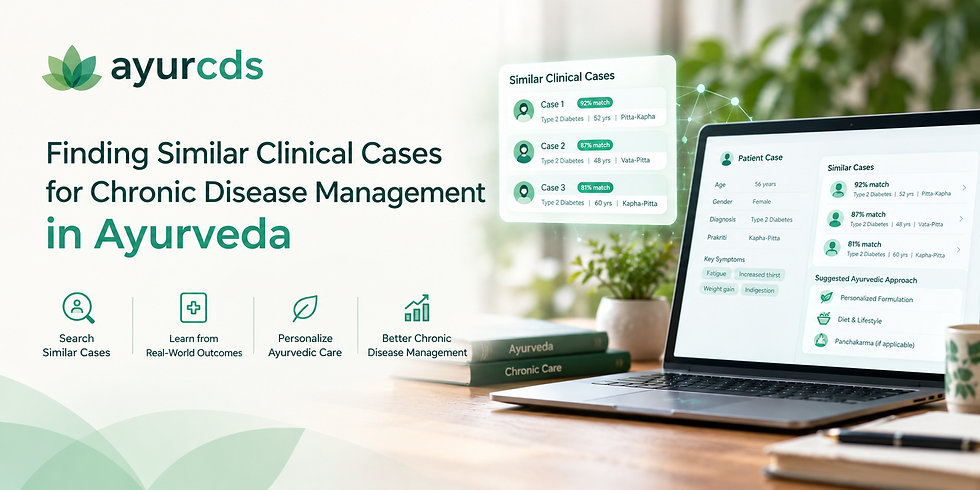
1. Structured Case Study Repository
AyurCDS provides doctors access to a curated repository of Ayurvedic clinical cases, where each case is structured into:
Case summary
Patient context
Treatment approach
Duration of care
Observed outcomes
Instead of reading long unstructured narratives, doctors can quickly review clinically relevant summaries during consultations.
2. Search by Age, Location, and Clinical Context
AyurCDS allows doctors to explore cases using practical clinical filters such as:
Age group (pediatric, adult, geriatric)
Geographical or regional patterns
Disease or symptom clusters
Chronic vs acute conditions
This helps doctors understand how treatments perform across demographics and regions, which is especially valuable in Ayurveda where geography and lifestyle influence disease manifestation.

3. Access to Treatment Plans and Outcome Patterns
For each case, AyurCDS highlights:
Treatment approaches used
Modifications across follow-ups
Outcome trends (improvement, stabilization, long-term management)
This enables doctors to:
Compare different treatment strategies
Learn from real-world outcomes
Avoid repeating ineffective approaches
Such insights support more confident and rational treatment planning without dictating decisions.
4. Integration of Journals and Clinical Literature
AyurCDS connects clinical cases with:
Published Ayurvedic journals
Institutional studies
Practice-based evidence
Instead of searching across multiple platforms, doctors can contextually reference literature relevant to the case they are managing—helping bridge the gap between classical knowledge, published research, and real practice.
5. Decision Support at the Point of Care
At the time of consultation, AyurCDS enables doctors to:
Review similar cases in seconds
Understand possible treatment pathways
Assess expected outcomes based on prior evidence
This does not replace clinical judgment. Instead, it supports Yukti with organized clinical intelligence, allowing doctors to make decisions with greater clarity and confidence.
How AyurCDS Organizes Ayurvedic Data into One Clinical Intelligence Layer
While Ayurvedic data exists in many forms, AyurCDS brings it together by:
Structuring unorganized case data into meaningful clinical units
Connecting treatment approaches with outcomes
Organizing experiential knowledge so it remains usable over time
Transforming scattered information into actionable insights for doctors
This approach ensures that valuable Ayurvedic clinical knowledge is not lost, forgotten, or siloed.
Benefits for Ayurvedic Doctors
With AyurCDS supporting treatment decision-making, doctors gain:
Faster access to relevant clinical experience
Greater confidence in treatment choices
Better understanding of outcome-driven care
Continuous learning from real-world cases
Support for evidence-informed Ayurveda
Conclusion
Ayurvedic treatment decision-making thrives on experience—but experience should be accessible, organized, and learnable, not scattered and forgotten.
AyurCDS assists doctors by transforming fragmented Ayurvedic case data, journals, and outcomes into a structured decision-support system that works at the point of care.
By organizing knowledge without interfering with classical principles, AyurCDS helps doctors practice more informed, confident, and outcome-oriented Ayurveda.


Comments