
Why PubMed and Google Scholar Fall Short for Ayurveda Doctors — And Why AyurCDS Was Built

Updated: Sep 13

Ayurveda doctors today have more access to research than ever before.With a few clicks, PubMed and Google Scholar can surface thousands of papers related to herbs, formulations, and diseases.
Yet, in the middle of a busy OPD, many Ayurvedic physicians quietly admit something:
“I have access to evidence — but not to clinical clarity.”
This gap between available research and usable clinical guidance is exactly why AyurCDS exists.
The Hidden Problem: Research Access ≠ Clinical Support
PubMed and Google Scholar are powerful — but they were never designed for point-of-care clinical decision-making.
They answer questions like:
What studies exist?
Who published them?
How many times were they cited?
They do not answer:
How should I reason through this case right now?
How do these findings apply to prakriti, samprapti, and chikitsa?
What do experienced Ayurveda clinicians actually do in similar situations?
For Ayurveda doctors, this difference matters.
Ayurveda Is Practiced in the Clinic — Not in PDFs
Ayurveda is a context-driven medical system.
Clinical decisions depend on:
individual constitution
disease evolution
response to previous treatments
physician judgment shaped by experience
PubMed and Google Scholar present information as isolated papers, often disconnected from:
classical reasoning frameworks
clinical pathways
real-world OPD constraints
AyurCDS was designed around the consultation itself, not around publication archives.
Why “More Papers” Often Means More Confusion
Searching Ayurveda topics on academic databases often leads to:
contradictory conclusions
inconsistent terminology
unclear clinical applicability
studies framed purely in biomedical language
Doctors must mentally translate:
modern disease labels → Ayurvedic understanding
statistical outcomes → clinical decisions
This translation burden is rarely acknowledged — but it consumes time and energy.
AyurCDS reduces this burden by curating and contextualizing evidence, instead of simply listing it.
Point-of-Care Support Changes Everything
There is a fundamental difference between:
reading evidence after clinic hours, and
using decision support during a consultation
AyurCDS is designed for the second scenario.
It supports:
structured clinical reasoning
disease-wise and symptom-wise navigation
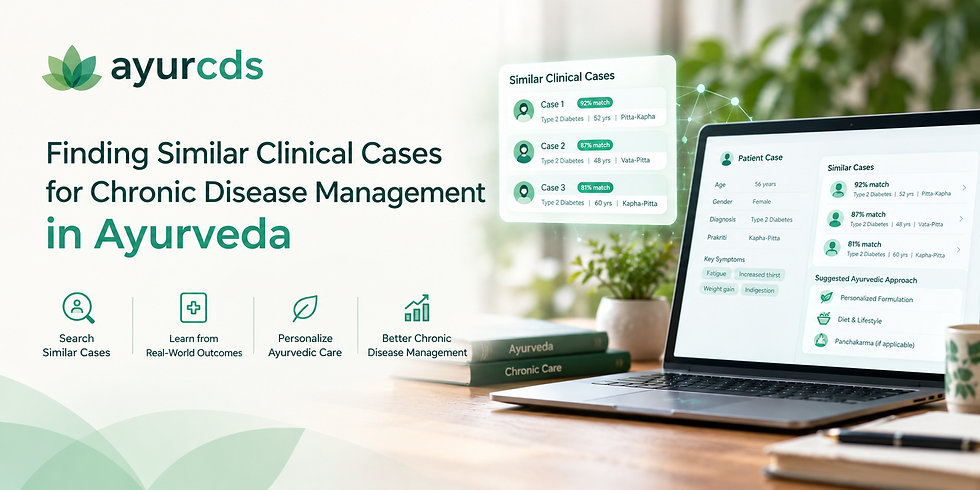
linking classical references with real-world cases
faster, clearer decision pathways
This is the same reason modern physicians rely on clinical decision support tools, not research databases, during patient care.
Ayurveda Needs Reasoning Support — Not Just Citations
PubMed tells you what has been studied.
AyurCDS helps you understand:
how Ayurveda clinicians reason
how decisions are made across similar cases
how classical knowledge is applied in practice
It integrates:
classical Ayurvedic references
documented clinical cases
practice-based evidence
clinician-oriented explanations
This reflects how Ayurveda is actually practiced — not how it is indexed academically.
Google Scholar Is Universal — Ayurveda Is Not
Google Scholar treats all medical systems as generic content.
It does not:
understand dosha-based logic
recognize samprapti patterns
differentiate chikitsa intent
organize knowledge for Ayurvedic workflows
AyurCDS is Ayurveda-native by design — built specifically for the intellectual structure of the system.

Evidence-Based Ayurveda Needs Its Own Model
Evidence-based practice in Ayurveda does not mean copying allopathic standards blindly.
It means:
combining literature with clinical experience
respecting classical foundations
learning from reproducible outcomes
documenting and refining real-world practice
AyurCDS supports this practice-based evidence model, while still linking to published research where appropriate.
PubMed and Google Scholar cannot perform this synthesis.
A Tool Designed for the Reality of OPD Practice
Ayurveda doctors are busy.
They need:
Clarity, not overload
Guidance, not hundreds of links
Support, not rigid protocols
AyurCDS acknowledges the time pressure and cognitive load of clinical practice and is built to assist — not distract — the physician.
Modern day practitioners use software tools to enhance their practice and improve treatment outcomes.
Not a Replacement — But a Better Fit
PubMed and Google Scholar remain essential for:
Research
Teaching
Publication
But they are not designed to guide clinical decisions at the point of care.
AyurCDS fills this missing layer.
Just as modern doctors use clinical decision support tools alongside research databases, Ayurveda doctors benefit from a system created specifically for Ayurvedic clinical reasoning.


Comments