
Why Google Isn’t Enough for Professional Ayurvedic Practice

Updated: Aug 9

The Real Difference Between Search and Decision Support
We search Google for almost everything.
Symptoms. Research papers. Treatment options. Clinical opinions. In seconds, we get thousands of results.
But in professional practice—especially in medicine—having information is not the same as making a decision.
And that difference matters more than ever.
The Problem Isn’t Lack of Information
Today’s clinicians don’t suffer from information scarcity.They suffer from information overload.
Search engines are incredibly good at finding content.They are not designed to answer the real question professionals face every day:
“What is the best decision for this specific case, right now?”
That gap between search and decision-making is where problems begin.
What Google Actually Does (and Doesn’t Do)
Google is built to:
Match keywords
Rank popularity and relevance
Serve content to a broad audience
It is not built to:
Understand patient context
Compare similar clinical cases
Preserve clinical reasoning
Support point-of-care decisions
For learning and exploration, Google is invaluable.For professional decision-making, it’s incomplete.
Why This Matters More in Clinical Practice
In real-world practice, professionals don’t ask:
“What articles exist on this topic?”
They ask:
“What should I do for this patient?”
That question requires:
Context, not just content
Experience, not just opinions
Patterns, not just keywords
Search engines return answers.They don’t support judgment.
Search vs Decision Support: The Core Difference
Search engines help you find information. Decision support systems help you apply knowledge.
Search Engines | Decision Support |
Keyword-based | Context-aware |
Generic results | Case-relevant insights |
Popularity-driven | Practice-driven |
Information retrieval | Clinical reasoning support |
For professionals, that distinction is critical.
Why Ayurveda Feels This Gap Even More
Ayurveda is not protocol-driven. It is individualized, pattern-based, and context-heavy.
Two patients with similar complaints may require:
Different treatments
Different dietary advice
Different timelines
When Ayurvedic practitioners rely solely on search engines, they often encounter:
Fragmented textbook knowledge
Theoretical answers disconnected from practice
No reference to real-world outcomes
Google wasn’t built for this level of personalization.
The Hidden Risk of “Google-Based Practice”
Using search engines as decision tools can lead to:
Oversimplified treatment choices
Copy-paste approaches
Loss of structured clinical reasoning
Inconsistent outcomes
Speed without structure is risky—especially in healthcare.
What Decision Support Systems Do Differently
A true clinical decision support system:
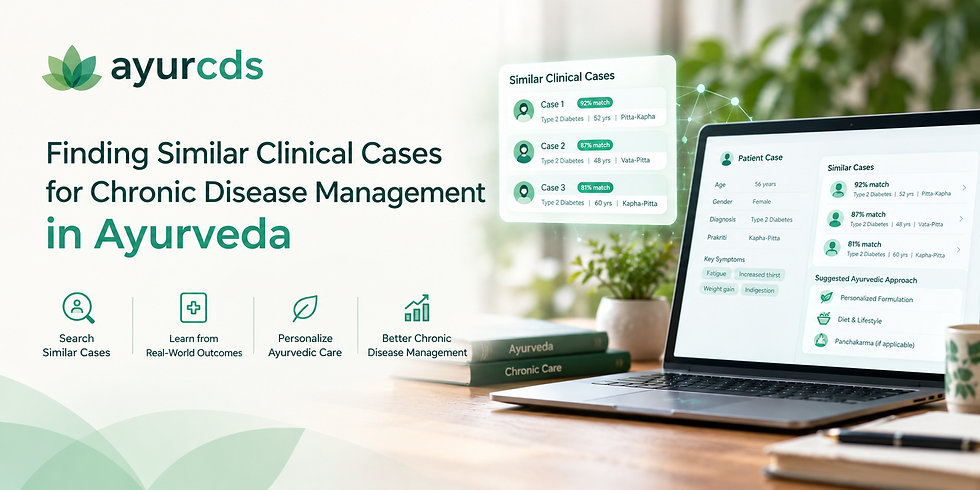
Organizes knowledge around cases, not pages
Preserves treatment logic and outcomes
Enables comparison with similar scenarios
Supports decisions at the time of care
Instead of opening 10 tabs, clinicians get focused, relevant insight.
Why AyurCDS Was Built
AyurCDS was created to address a simple but critical gap:
Ayurveda needed decision support, not another search engine.
AyurCDS focuses on:
Structured Ayurvedic clinical cases
Practice-based evidence
Pattern recognition across patient profiles
Support for real-world decision-making
It doesn’t replace clinical judgment. It strengthens it.
Google vs AyurCDS: A Practical View
AyurCDS | |
Open web content | Curated clinical cases |
Information-focused | Decision-focused |
Generic results | Ayurveda-native |
Learning tool | Point-of-care tool |
Google helps you learn. AyurCDS helps you decide.
Why Decision Support Reduces Cognitive Load
In busy practice settings, professionals don’t need:
More articles
More opinions
More tabs
They need:
Relevant prior cases
Observed outcomes
Clear clinical patterns
Decision support systems reduce mental strain while preserving professional autonomy.
The Future Isn’t “Search vs Doctors”
The future is:
Search for learning
Decision support for practice
Clinical judgment at the center
As healthcare becomes more complex, tools must evolve from information providers into thinking companions.
AyurCDS represents this shift for Ayurveda.
The Takeaway
Search engines answer questions.Decision support systems support decisions.
For professional practice—especially in Ayurveda, where personalization and experience matter deeply—Google alone is not enough.
Information tells you what exists.Decision support helps you choose what works.
That difference defines the future of evidence-based Ayurvedic practice.


Comments