
What If Ayurvedic Prescription Recommendations Could Be Data-Driven?


Ayurveda has always been a science of careful observation and profound individualization. A competent physician does not simply match symptoms to a formula. Instead, they evaluate Prakriti, Vikriti, Agni, Ama, Srotas, season, age, geographical location, mental state, and the unique Samprapti of each patient before arriving at a prescription. This classical approach remains the gold standard of authentic Ayurvedic practice.Yet a persistent gap exists in everyday clinical life. While the theoretical knowledge of Ayurveda is vast and well-documented in the Samhitas, the practical, real-world application of that knowledge—across thousands of similar cases—is often fragmented, difficult to retrieve, and heavily dependent on individual memory or limited journal access.
What if Ayurvedic prescription recommendations could become systematically data-driven?
What if physicians could draw upon organized clinical experience at the exact moment of decision-making, without compromising classical principles or physician autonomy?
This question is no longer purely theoretical. Platforms designed specifically for Ayurveda are beginning to make data-informed clinical support a practical reality.
The Limitations of Traditional Decision-Making in Daily Practice
Most Ayurvedic physicians currently rely on a combination of the following sources when formulating a prescription:
Source of Knowledge | Strengths | Limitations in Daily Practice |
Classical texts (Charaka, Sushruta, etc.) | Deep foundational principles | Not case-specific; requires extensive interpretation |
Personal clinical experience | Highly contextual and nuanced | Limited by individual exposure and memory |
Senior physician guidance | Mentorship and practical wisdom | Not always available in real time |
Published case reports | Real patient outcomes | Scattered across journals; hard to search quickly |
Continuing education / conferences | New insights and discussions | Infrequent and not point-of-care accessible |
While each of these sources is valuable, none provides rapid, filterable access to large volumes of comparable clinical cases during a consultation. As a result, valuable patterns—such as which formulations tend to work better in specific Prakriti types, age groups, or regions—often remain invisible or underutilized.
What “Data-Driven” Really Means in an Ayurvedic Context
Data-driven prescription support in Ayurveda does not mean algorithmic diagnosis or standardized protocols imposed on every patient. Instead, it means:
Organizing real-world clinical cases in a structured, searchable format
Allowing physicians to filter cases by clinically relevant parameters
Surfacing patterns in diagnosis, treatment choices, and outcomes
Supporting the physician’s classical reasoning with additional context
The final prescription remains entirely under the control of the qualified Ayurvedic physician. The data simply expands the range of clinical precedents available for consideration.
Key Clinical Parameters That Can Be Data-Supported
When case data is properly curated and structured, several parameters become especially useful for refining prescription decisions:
Clinical Parameter | Why It Matters in Ayurveda | How Data Support Helps |
Prakriti (Constitution) | Influences treatment response and formulation choice | Reveals patterns across Vata, Pitta, Kapha dominant cases |
Age Group | Affects Agni, tissue strength, and dosage | Shows age-specific treatment trends and outcomes |
Geographical Location | Climate and local factors influence Samprapti | Highlights regional variations in successful approaches |
Chief Complaints / Nidana | Core of diagnostic reasoning | Enables matching of similar symptom clusters |
Treatment Protocol | Choice of herbs, formulations, and procedures | Compares protocols and associated outcomes |
Outcome Assessment | Measures actual clinical results | Provides evidence of what worked under similar conditions |
By examining these dimensions across multiple cases, physicians gain a broader clinical perspective while still applying classical logic to the individual patient in front of them.
How a Data-Driven Approach Strengthens Clinical Practice
When structured case data becomes available at the point of care, several practical benefits emerge:
1. Faster access to relevant clinical precedents
Instead of spending valuable consultation time searching through journals or relying solely on memory, physicians can quickly review comparable cases.
2. Improved pattern recognition
Trends that would take years of individual experience to notice become visible earlier—such as differential responses to the same formulation in different Prakriti types.
3. Support for complex and chronic cases
In multifactorial or long-standing conditions, reviewing how similar cases were managed and what outcomes were achieved can increase confidence and reduce uncertainty.
4. Enhanced learning for students and early-career physicians
Structured case repositories serve as powerful educational tools, bridging the gap between textbook knowledge and real clinical application.
5. Better documentation and research readiness
Clinics and institutions that systematically record and review cases generate practice-based evidence that can contribute to the broader scientific foundation of Ayurveda.
AyurCDS: Making Data-Driven Support Practical
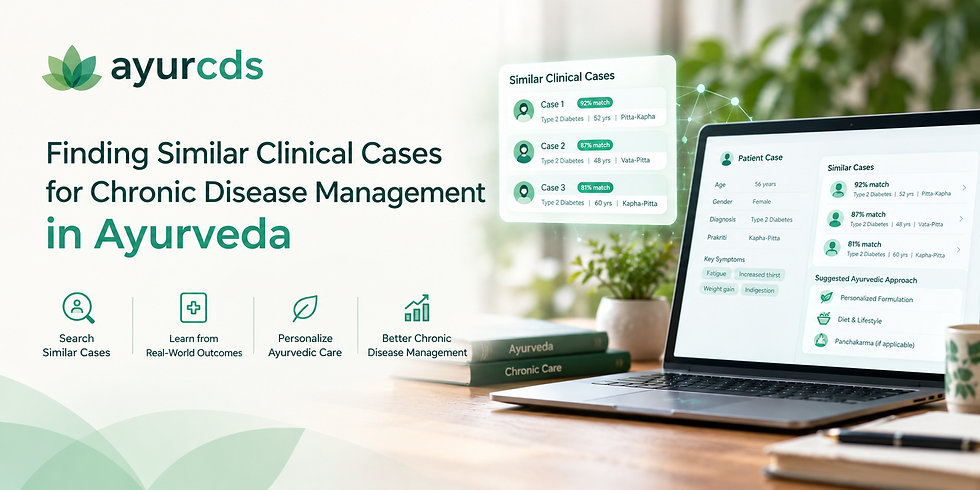
AyurCDS was developed specifically to address these needs. It functions as a clinical decision support and knowledge platform built for Ayurvedic physicians, educators, and researchers.Core features include:
Feature | Description | Clinical Benefit |
Curated Case-Report Repository | Large collection of cases from journals and practitioner experience | Access to real-world clinical knowledge |
Advanced Search & Filtering | Filter by age group, Prakriti, location, symptoms, and more | Rapid identification of relevant precedents |
Structured Clinical Data | Patient details, diagnosis, treatment protocols, formulations, and outcomes | Clear, comparable case information |
Evidence-Based Medicine Approach | Integrates available clinical data with physician expertise | Supports informed, personalized decision-making |
Point-of-Care Usability | Designed for use during active consultations | Practical support without disrupting workflow |
Cross-Device Accessibility | Usable across desktop and mobile devices | Flexibility in clinic and academic settings |
Importantly, AyurCDS does not diagnose patients or generate autonomous prescriptions. It organizes clinical inputs, presents relevant decision pathways and case insights, and leaves final judgment entirely with the qualified physician.
Addressing Common Concerns
Some practitioners may worry that introducing data systems could dilute classical Ayurveda. In reality, the opposite is possible when the system is designed correctly. Data-driven tools can:
Reinforce classical frameworks by making them operationally useful
Preserve individualization rather than enforcing uniformity
Elevate the role of clinical observation and outcome tracking
Support the transition of Ayurveda toward greater accountability and evidence strength without abandoning its philosophical roots
The goal is not to replace the physician’s expertise, but to amplify it with organized clinical intelligence.
Looking Toward the Future
The next phase of Ayurvedic clinical practice will likely combine three essential elements:
Deep classical knowledge
Individualized clinical judgment
Structured, accessible real-world data
When these three work together, prescription recommendations become more informed, more consistent where consistency is beneficial, and more precisely tailored where individualization is required. Data-driven support is not about making Ayurveda less traditional. It is about giving traditional wisdom better tools to operate effectively in the complexity of modern clinical environments.
Conclusion
What if Ayurvedic prescription recommendations could be data-driven? The answer is that they already can be—when the right systems are in place. By organizing clinical cases, enabling intelligent filtering, and presenting outcomes in a usable format, platforms like AyurCDS help physicians move from isolated experience toward collective clinical intelligence. The physician remains at the center. Classical principles remain the foundation. Data simply makes that foundation more accessible and actionable at the point of care.For Ayurvedic doctors, clinics, educators, and researchers who want to strengthen evidence-informed practice while staying true to the tradition, exploring such tools is no longer optional—it is a natural next step.Learn more about how AyurCDS supports clinical decision-making at www.ayurcds.com.


Comments