
How AyurCDS Transforms Ayurveda Case Reports into an Actionable Clinical Knowledge Base


Every Clinical Case Holds Valuable Knowledge
Every day, Ayurvedic doctors diagnose complex conditions, prescribe individualized treatments, and observe patient outcomes. Each consultation generates valuable clinical knowledge. However, much of this experience remains confined to handwritten notes, hospital records, or the clinician's memory.
As a result, years of valuable clinical experience often become difficult to retrieve, compare, or reuse when managing similar patients.
AyurCDS addresses this challenge by transforming individual Ayurveda case reports into a searchable, structured, and actionable clinical knowledge base that helps practitioners make faster, evidence-informed clinical decisions.
The Challenge with Traditional Ayurveda Case Documentation
Ayurveda case reports contain rich clinical information, including:
Patient demographics
Prakriti and Vikriti assessment
Dosha involvement
Agni and Ama status
Nidana (causative factors)
Lakshana (clinical features)
Samprapti (pathogenesis)
Chikitsa Siddhanta (treatment principles)
Medicines and formulations
Panchakarma procedures
Diet and lifestyle recommendations
Clinical outcomes
Follow-up observations
While this information is highly valuable, it is often stored in formats that make retrieval difficult. Finding similar cases may require searching through numerous records or relying on personal recollection.
Without structured organization, important clinical insights remain underutilized.
From Individual Cases to Collective Clinical Intelligence
AyurCDS goes beyond storing case reports. It converts them into a structured clinical knowledge repository that practitioners can explore during patient care.
Instead of asking:
"Where did I treat a similar patient?"
Doctors can quickly search for:
Similar disease presentations
Comparable Dosha imbalances
Specific Prakriti profiles
Treatment approaches
Classical references
Frequently used formulations
Observed clinical outcomes
This transforms isolated case records into reusable clinical knowledge.
Making Case Reports Searchable
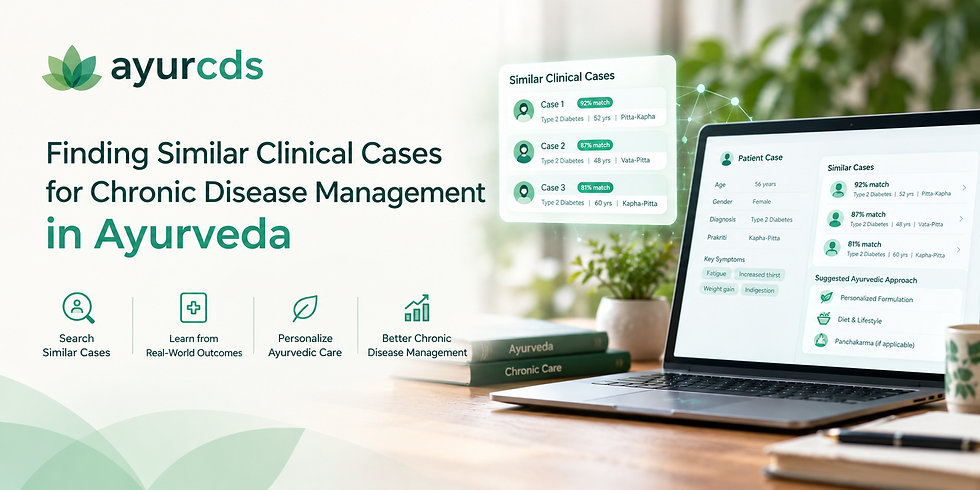
One of the biggest advantages of a digital clinical knowledge base is intelligent search.
AyurCDS enables clinicians to search cases using multiple clinical parameters, such as:
Disease or diagnosis
Prakriti
Age group
Gender
Geographic location
Instead of reviewing hundreds of records manually, doctors can rapidly identify clinically relevant cases.
Supporting Evidence-Informed Ayurveda Practice
Evidence-informed practice in Ayurveda extends beyond published research papers. It also includes carefully documented clinical experience.
When case reports are consistently structured and searchable, they become an important source of real-world clinical evidence.
A searchable knowledge base allows practitioners to:
Learn from previous successful treatments
Compare different therapeutic approaches
Recognize recurring clinical patterns
Improve consistency in decision-making
Support academic discussions and research
This helps bridge traditional clinical wisdom with modern knowledge management.
Connecting Classical Knowledge with Real-World Practice
Ayurvedic clinical reasoning is rooted in classical principles. However, clinicians also benefit from understanding how these principles have been applied in contemporary practice.
AyurCDS helps connect:
Classical references
Modern research literature
Clinical case reports
Treatment experiences
Outcome observations
This integrated approach enables practitioners to move seamlessly between theory and clinical application.
Benefits for Clinics, Hospitals, and Institutions
A structured clinical knowledge base offers value beyond individual practitioners.
For Clinics
Preserve valuable clinical experience
Improve consistency across practitioners
Reduce dependence on personal memory
Enable faster clinical information retrieval
For Hospitals
Build institutional clinical knowledge
Support quality improvement initiatives
Facilitate collaborative learning
Strengthen documentation practices
For Academic Institutions
Develop teaching case libraries
Support postgraduate education
Encourage case-based learning
Promote clinical research
A Foundation for Future Clinical Decision Support
Well-structured case repositories create opportunities for advanced clinical decision support.
Over time, organized clinical knowledge may help identify:
Frequently successful treatment patterns
Common Dosha associations
Trends across diseases
Practice variations
Real-world therapeutic outcomes
Such insights can support practitioners while preserving the individualized nature of Ayurveda.
Why Structured Case Knowledge Matters
Every Ayurvedic consultation contributes to the collective growth of the profession. When clinical experiences remain isolated, valuable knowledge is easily lost. When they are systematically organized, they become an enduring resource for education, research, and patient care.
By transforming case reports into a searchable clinical knowledge base, AyurCDS helps preserve practitioner expertise, improve knowledge accessibility, and support evidence-informed clinical practice. Rather than functioning as a simple repository of records, it enables clinicians to learn from past experiences, identify relevant cases efficiently, and make more informed decisions at the point of care.
As Ayurveda continues its digital transformation, structured clinical knowledge systems have the potential to become an essential component of modern Ayurvedic practice, helping convert everyday clinical experience into knowledge that benefits practitioners today and future generations.
Frequently Asked Questions
What is an Ayurveda clinical knowledge base?
An Ayurveda clinical knowledge base is a structured digital repository that organizes clinical cases, treatment approaches, classical references, and research evidence into a searchable format that supports clinical decision-making.
How is AyurCDS different from a case record system?
Traditional case record systems primarily store patient information. AyurCDS organizes clinical knowledge so practitioners can search, compare, and learn from previous cases to support future clinical decisions.
Can AyurCDS help doctors find similar clinical cases?
Yes. AyurCDS enables clinicians to search case reports using multiple parameters such as disease, symptoms, Dosha, Prakriti, medicines, patient demographics, and treatment outcomes, allowing rapid retrieval of clinically relevant cases.
Why are searchable case reports important in Ayurveda?
Searchable case reports help preserve valuable clinical experience, support evidence-informed practice, improve knowledge sharing, facilitate research, and enhance clinical learning by making past treatment experiences easily accessible.


Comments