
How Structured Clinical Cases Can Transform Ayurvedic E-Learning

Updated: 2 days ago

Ayurvedic e-learning has grown rapidly in recent years. Online courses, recorded lectures, digital libraries of classical texts, and virtual classrooms now make foundational knowledge more accessible than ever. Yet one critical gap remains: many students and practitioners still struggle to translate theoretical concepts into confident clinical decision-making.This is where structured clinical cases can transform Ayurvedic e-learning. By organizing real-world patient scenarios into searchable, filterable, and educationally designed formats, digital platforms can bridge the long-standing divide between classical theory and practical application. In this article, we explore how structured clinical cases improve Ayurvedic education, the limitations of traditional e-learning models, and how modern clinical decision support platforms are reshaping the learning experience for students, interns, and practicing physicians.
The Current State of Ayurvedic E-Learning
Most Ayurvedic e-learning programs focus on delivering content in the following formats:
Learning Format | Common Strengths | Common Limitations |
Video lectures on Samhitas | Clear explanation of classical principles | Limited connection to real patient scenarios |
PDF notes and slide decks | Easy to review and revise | Passive and non-interactive |
Multiple-choice quizzes | Useful for knowledge testing | Rarely assess clinical reasoning |
Recorded case discussions | Offer some clinical insight | Often unstructured and hard to search |
Live webinars | Interactive and engaging | Ephemeral; difficult to revisit systematically |
While these methods effectively transmit theoretical knowledge, they frequently fall short in developing the clinical judgment required in actual practice. Students may memorize Nidana and Chikitsa principles yet feel unprepared when facing complex, multi-factorial patient presentations.
Why Structured Clinical Cases Matter in Ayurvedic Education
Structured clinical cases convert scattered clinical experience into organized learning assets. Instead of isolated anecdotes or lengthy unedited case discussions, well-designed cases present information in a consistent, educationally useful format.A structured clinical case typically includes:
Patient demographics and relevant history
Prakriti and Vikriti assessment
Chief complaints and associated symptoms
Diagnostic reasoning (Samprapti)
Treatment protocol and formulations used
Follow-up and outcome notes
Key learning points or discussion questions
When these elements are standardized and made searchable, clinical cases become powerful tools for e-learning.
Key Benefits of Structured Clinical Cases in Ayurvedic E-Learning
Benefit | How It Transforms Learning | Impact on Learners |
Students practice applying classical principles to real scenarios | Builds confidence in diagnostic thinking | |
Pattern recognition | Exposure to multiple similar cases reveals treatment trends | Accelerates experiential learning |
Contextual understanding | Cases show how age, Prakriti, and location influence decisions | Deepens appreciation of individualization |
Learners can filter cases by condition, Dosha, or age group | Enables self-directed, targeted study | |
Continuous learning for practitioners | Working doctors can revisit relevant cases during practice | Supports lifelong professional development |
Standardization of teaching | Educators can assign consistent, high-quality case material | Improves curriculum quality and assessment |
These advantages address one of the core challenges in Ayurvedic education: moving from “knowing the theory” to “applying the theory effectively.”
How Structured Cases Enhance Different Stages of Learning
For Undergraduate Students
Structured cases help beginners see how abstract concepts such as Agni, Ama, and Srotodushti appear in real patients. This early exposure reduces the theory-practice gap that many students experience during clinical postings.
For Postgraduate Scholars and Interns
Advanced learners can analyze treatment variations, compare outcomes, and critically evaluate different therapeutic approaches. Filtering cases by specific parameters supports research-oriented thinking and thesis preparation.
For Practicing Physicians
Even experienced doctors benefit from rapid access to comparable cases, especially when managing uncommon or complex presentations. Structured repositories turn e-learning into a continuous clinical reference tool rather than a one-time course.
Comparison: Traditional vs. Structured Case-Based E-Learning
Aspect | Traditional E-Learning | Structured Case-Based E-Learning |
Primary focus | Knowledge transmission | Clinical reasoning and application |
Case material | Occasional, unstructured discussions | Curated, consistently formatted cases |
Searchability | Limited or absent | Filterable by Prakriti, age, location, symptoms |
Learning style | Passive consumption | Active analysis and pattern recognition |
Relevance to daily practice | Moderate | High – usable at point of care |
Suitability for assessment | Mostly theoretical quizzes | Case-based evaluation of clinical judgment |
Longevity of value | Course-dependent | Ongoing reference resource |
The shift from passive content delivery to active, case-driven learning represents a significant upgrade in educational quality.
The Role of Digital Platforms in Delivering Structured Clinical Cases
Modern clinical knowledge platforms make structured case-based learning scalable. Features that particularly support Ayurvedic e-learning include:
Large repositories of curated case reports drawn from journals and clinical practice
Advanced filtering by clinically relevant parameters (age group, Prakriti, location, diagnosis)
Clear presentation of treatment protocols and outcomes
Cross-device accessibility for study and clinical reference
Integration of evidence-informed insights with classical frameworks
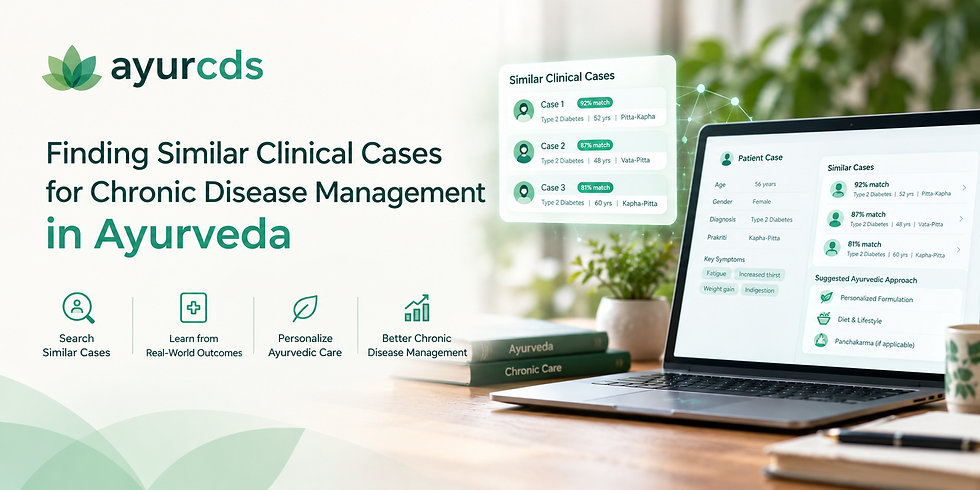
Platforms designed specifically for Ayurveda, such as AyurCDS, exemplify this approach. By organizing real-world clinical knowledge into a searchable decision-support and learning environment, they enable both formal education and continuous professional development.
Practical Ways Institutions Can Integrate Structured Cases
Ayurvedic colleges and online course providers can leverage structured clinical cases in several high-impact ways:
Case-based modules within existing curriculum subjects
Weekly clinical reasoning assignments using filtered case sets
Virtual grand rounds built around curated cases
Assessment tools that evaluate diagnostic and therapeutic decision-making
Research training through analysis of outcome patterns across case series
When combined with classical text study, structured cases create a more complete and practice-ready educational experience.
Conclusion: Building the Future of Ayurvedic Education
Structured clinical cases have the potential to fundamentally transform Ayurvedic e-learning. They move education beyond passive knowledge transfer toward active clinical skill development. Students gain clearer insight into how classical principles operate in real patients. Practitioners gain an ongoing source of relevant clinical precedents. Educators gain consistent, high-quality material for teaching and assessment.The future of Ayurvedic education lies in combining the depth of classical wisdom with the accessibility and organization of modern digital tools. Structured clinical cases sit at the heart of this evolution.Platforms that curate and present clinical cases in an educationally useful format—such as AyurCDS—are already making this transformation practical. By supporting both learning and clinical decision-making, they help ensure that the next generation of Ayurvedic physicians is not only knowledgeable but clinically confident.Explore how structured clinical cases can enhance teaching, learning, and practice at www.ayurcds.com.


Comments