
Finding Similar Clinical Cases for Chronic Disease Management in Ayurveda

Updated: 4 days ago
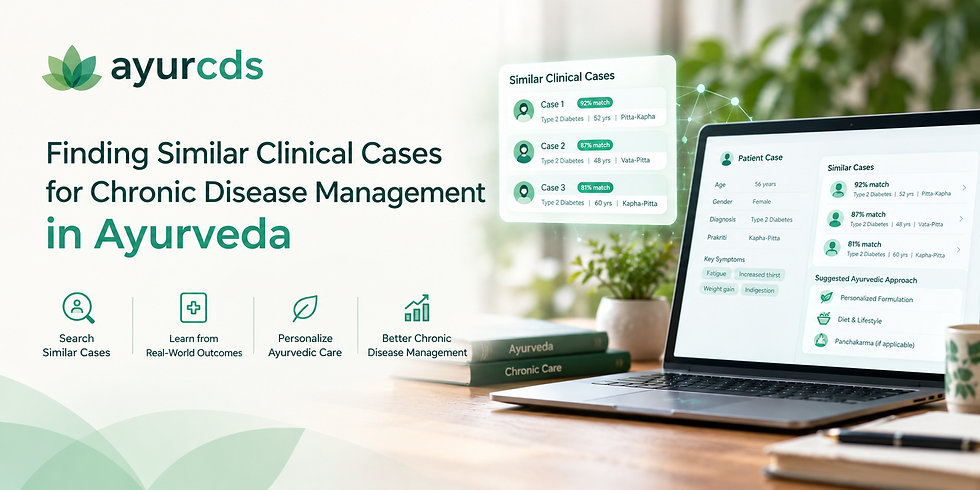
Chronic diseases present some of the most complex challenges in clinical practice. Conditions such as diabetes, arthritis, skin disorders, respiratory illnesses, and metabolic syndromes often involve multiple Dosha imbalances, long-standing Samprapti, and highly individualized responses to treatment. In Ayurveda, successful management depends on precise assessment of Prakriti, Vikriti, Agni, and other patient-specific factors.Yet even experienced physicians can benefit from reviewing how similar patients have been managed in real clinical settings. Using AyurCDS to find similar clinical cases for chronic disease management offers a practical way to access curated, real-world case data at the point of care—supporting more informed, confident, and personalized treatment decisions.This article explains why similar case matching matters in chronic care, how AyurCDS enables this process, and the clinical advantages it brings to Ayurvedic practice.
Challenges in Managing Chronic Diseases with Ayurveda
Chronic conditions rarely follow a single, linear pathway. Physicians commonly face these difficulties:
Challenge | Impact on Clinical Practice |
Long and evolving Samprapti | Treatment plans need ongoing refinement |
High individual variability | Same diagnosis may require different approaches |
Limited access to comparable cases | Physicians rely mainly on personal experience |
Scattered published case reports | Time-consuming to locate relevant examples |
Outcome tracking across similar patients | Difficult to identify patterns of success or failure |
Without easy access to structured clinical precedents, decision-making can become more time-intensive and less informed by broader clinical experience.
Why Finding Similar Clinical Cases Matters
Reviewing similar cases helps physicians:
Recognize treatment patterns that have worked in comparable patients
Understand how factors such as age, Prakriti, and location influence outcomes
Gain insight into formulation choices, dosages, and adjunct therapies
Reduce uncertainty in complex or treatment-resistant presentations
Continuously learn from real-world clinical experience
This approach strengthens classical reasoning rather than replacing it. The physician remains fully responsible for the final prescription while benefiting from organized clinical intelligence.
How AyurCDS Supports Similar Case Matching
AyurCDS is a clinical decision support and knowledge platform designed specifically for Ayurvedic physicians. One of its core strengths is the ability to search and filter a curated repository of clinical cases to identify those most relevant to the patient at hand.
Key capabilities that support chronic disease management include:
Feature | How It Helps in Chronic Care |
Curated case-report repository | Access to cases drawn from journals, practitioner experience, and clinical sources |
Advanced search and filtering | Narrow results by age group, Prakriti, location, symptoms, and other parameters |
Clear view of diagnosis, treatment protocols, formulations, and outcomes | |
Point-of-care usability | Quick reference during consultations without disrupting workflow |
Evidence-informed insights | Patterns from real-world cases support more confident decisions |
By matching current patient parameters with comparable historical cases, AyurCDS helps clinicians evaluate treatment options more accurately.
Practical Workflow: Finding Similar Cases in AyurCDS
A typical process for using AyurCDS in chronic disease management looks like this:
Enter key patient parameters – Age range, Prakriti, primary complaints, and relevant clinical features.
Apply filters – Refine the search by location, disease category, or treatment focus.
Review matched cases – Examine diagnostic details, therapeutic interventions, and reported outcomes.
Compare patterns – Note recurring successful formulations, lifestyle recommendations, or procedural approaches.
Integrate with clinical judgment – Adapt insights to the individual patient while remaining grounded in classical principles.
This structured approach turns scattered case knowledge into an actionable clinical resource.
Benefits for Chronic Disease Management
Using AyurCDS to locate similar clinical cases delivers several practical advantages:
Benefit | Clinical Impact |
Faster access to relevant precedents | Saves time during busy consultations |
Better pattern recognition | Reveals what has worked in similar Prakriti and age groups |
Improved treatment personalization | Supports more precise formulation and protocol choices |
Greater confidence in complex cases | Reduces uncertainty when managing long-standing conditions |
Continuous professional learning | Turns everyday practice into an ongoing educational process |
Support for evidence-informed care | Strengthens decision-making with real-world outcome data |
These benefits are especially valuable in chronic care, where treatment is iterative and outcomes unfold over weeks or months.
Example Application Areas
AyurCDS can support case matching across a wide range of chronic presentations, including:
Metabolic disorders (e.g., diabetes-related conditions)
Musculoskeletal and joint disorders
Chronic skin diseases
Respiratory and allergic conditions
Digestive and metabolic imbalances
Stress-related and psychosomatic presentations
In each area, the ability to filter by patient-specific factors helps surface the most clinically relevant precedents.
Conclusion
Effective chronic disease management in Ayurveda requires both deep classical knowledge and access to real-world clinical experience. Using AyurCDS to find similar clinical cases for chronic disease management bridges these two elements. By enabling physicians to search, filter, and review structured case data based on parameters such as age, Prakriti, and clinical features, the platform supports more informed, individualized, and confident decision-making.The physician remains at the center of care. Classical principles continue to guide diagnosis and treatment. Structured case matching simply makes the collective clinical wisdom of Ayurveda more accessible and useful at the point of care.
For Ayurvedic doctors seeking to strengthen their approach to chronic conditions with data-informed insights, exploring AyurCDS is a practical next step.Learn more and experience how similar clinical case matching can support your practice at www.ayurcds.com.


Comments