
Evidence-Based, Data-Driven Ayurveda: The Future Clinical Practice

Updated: Sep 13

Ayurveda is one of the oldest medical systems in the world — holistic, individualized, and rooted deeply in clinical experience and textual wisdom. Yet in today’s healthcare environment, credibility, reliability, and reproducibility are increasingly shaped by data, structured evidence, and measurable outcomes. For Ayurveda to progress — without losing its soul — it must evolve into an evidence-based, data-driven practice.
Why Evidence Matters in Ayurveda
Modern healthcare prioritizes:
Reproducible results
Transparent clinical data
Standard treatment protocols
Outcome-focused practice
Traditionally, Ayurveda has relied on two pillars:
Classical texts such as Charaka Samhita and Sushruta Samhita that outline diagnosis, pathogenesis, and treatment principles (e.g., tridosha, agni, dhatus).
Practitioner experience and case-to-case learning.
These are undeniably valuable, but relying solely on text and personal recall has practical limitations — especially when measured against today’s expectation for evidence that can be evaluated, indexed, and queried systematically.
The Gap: Tradition vs. Structured Evidence
Even though promising research exists showing positive effects for certain Ayurvedic therapies (such as improvements in lipid profiles and immune function), systematic, high-quality data remains limited.
This is not unique to Ayurveda. Traditional medicine systems globally face similar challenges:
A lack of standardized outcome documentation
Limited real-time decision support
Diversity in clinical approaches across practitioners
Difficulty aggregating individual experience into broader insights
What “Evidence-Based Ayurveda” Really Means
Evidence-based Ayurveda is not about replacing classical foundations with modern science. It’s about enhancing clinical reliability and consistency, by:
Documenting clinical outcomes
Identifying patterns across diverse patient profiles
Aligning ancient diagnostic logic with observable data
Supporting clinicians with tools that retrieve relevant insights quickly
Ultimately, it’s a bridge between time-tested wisdom and structured, queryable evidence.
The Rise of Data-Driven Practice in Ayurveda
Data is the backbone of modern decision making — whether in insurance, e-commerce, or healthcare. For Ayurveda, data transforms:
Practice workflows
Treatment optimization
Patient stratification
Predictive insights
Structured data allows clinicians to see beyond individual memory and experience, making it possible to answer questions like:
What treatments work best for specific prakriti-vikriti combinations?
How have similar cases responded over time?
Which formulations show consistent outcomes across demographics?
This is where data-driven Ayurveda becomes more than a concept — it becomes clinical practice.
AyurCDS: A Real-World Step Toward Evidence-Based, Data-Driven Ayurveda
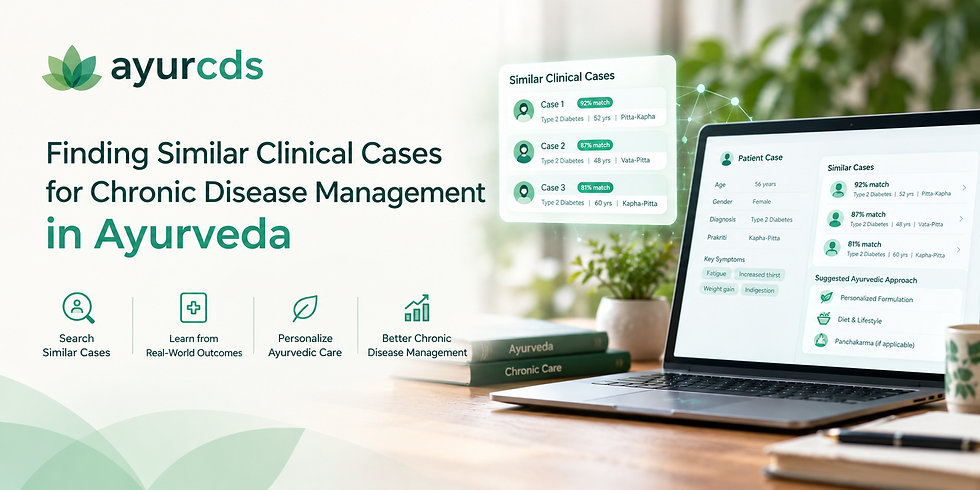
AyurCDS is a clinical decision support system (CDSS) designed specifically for Ayurveda doctors and practitioners. It fills the critical gap between unstructured experience and structured evidence. AyurCDS
Here’s how it empowers evidence-based practice:
1. Curated Clinical Case Repository
AyurCDS organizes real clinical case reports — with patient profiles, diagnosis, treatment protocols, and outcomes — into a searchable, structured database. This enables clinicians to learn from precedent and glean insights that are meaningful at the point of care. AyurCDS
2. Data-Driven Decision Support
Doctors can filter cases by:
Prakriti
Age group and demographics
Treatment response patterns
This empowers evidence-aligned clinical reasoning, not just theoretical recall.
3. Clinical Pattern Recognition
By observing aggregated outcomes from multiple cases, AyurCDS reveals treatment trends and helps predict likely responses — reducing reliance on guesswork or anecdotal memory. AyurCDS
4. Point-of-Care Insights
Unlike static references, AyurCDS is accessible in real time during consultations, helping doctors:
Confirm diagnostic pathways
Compare similar historical cases
Review outcomes before deciding treatment. This ensures precision without disrupting clinical flow. AyurCDS
Data + Technology = Tradition Evolved, Not Replaced
The goal of combining data with Ayurveda isn’t to force it into a biomedical mold. It is to make it:
Structured
Transparent
Searchable
Outcome-focused
This evolution supports both clinician confidence and patient understanding.
Moreover, technology such as AI and analytical tools can enhance pattern discovery — *but only when fueled by quality clinical data, not isolated anecdotes. AyurCDS
The Bigger Picture: Why This Matters Now
Today, Ayurvedic practice sits at an important crossroads:
📍 Increasing demand for personalized care
Patients are seeking therapies that work in context — not just in theory.
📍 Rising expectations for reproducible results
Healthcare professionals and institutions now increasingly value documented outcomes.
📍 Digital transformation of healthcare
Healthcare ecosystems are digitizing rapidly — Ayurveda must adapt to remain relevant.
This transformation doesn’t dilute Ayurveda; it reveals its strengths more clearly and measurably.
How Practitioners, Students, and Institutions Benefit
For Clinicians:
Improved diagnostic accuracy
Better treatment consistency
Confidence in clinical decisions
For Students and Academics:
Access to structured case learning
A living repository of real outcomes
For Institutions and Researchers:
Data for outcomes research
Foundation for future clinical studies
Conclusion: Ayurveda’s Next Chapter Is Evidence + Data
Ayurveda’s philosophical foundations have endured for thousands of years. But as healthcare systems evolve, so too must the tools that support clinical practice.
Evidence-based, data-driven Ayurveda is not a compromise — it is its next logical evolution. With platforms like AyurCDS, clinicians don’t have to choose between tradition and modernity. They can practice Ayurveda that is both ancient in principle and modern in impact — measurable, transparent, and actionable.
The future of Ayurveda lies not in abandoning its roots, but in structuring its wisdom in ways that today’s clinicians can use confidently and consistently


Comments