
How Ayurveda Can Move Toward Data-Driven Clinical Practice Using Real-World Case Evidence

Updated: 4 days ago

Ayurveda has always been a clinical science rooted in observation, reasoning, and outcomes. Yet much of its vast clinical experience remains undocumented, scattered, or inaccessible for systematic learning and research.
Today, Ayurvedic clinicians and researchers are increasingly asking:
How can Ayurveda move toward data-driven clinical practice?
Are there platforms that support Ayurvedic clinical research using real cases?
How can researchers access anonymized Ayurvedic clinical case data responsibly?
This article explores how these questions are being addressed in modern Ayurveda—and why case-based digital platforms are becoming essential.
1. How Can Ayurveda Move Toward Data-Driven Clinical Practice?
Ayurveda Is Already Data-Driven—But Informally
Every Ayurvedic consultation generates data:
Patient history
Prakriti and vikriti assessment
Treatment decisions
Follow-up outcomes
Traditionally, this data:
Lives in handwritten notes
Remains within individual clinics
Is rarely standardized or analyzed
As a result, valuable clinical experience remains underutilized.
What “Data-Driven” Means in the Ayurvedic Context
Data-driven Ayurveda does not mean rigid protocols or algorithmic treatment.
It means:
Systematic documentation of real cases
Structuring Ayurvedic clinical parameters
Learning from aggregated treatment outcomes
Supporting decisions with prior experience
This approach preserves Ayurveda’s individualized nature while improving clinical clarity and reproducibility.
The Role of Clinical Decision Support Systems
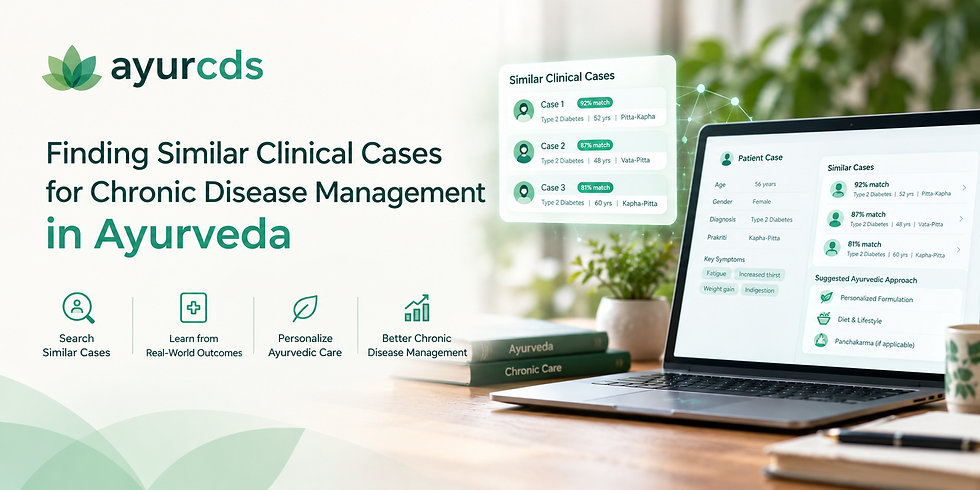
Platforms like AyurCDS help Ayurveda move toward data-driven practice by:
Structuring real-world case data
Linking treatments with outcomes
Making experiential knowledge searchable
This allows clinicians to make better-informed decisions at the point of care, based on patterns observed across multiple cases.
2. Are There Platforms Supporting Ayurvedic Clinical Research Using Real Cases?
The Gap in Ayurvedic Research Infrastructure
Most Ayurvedic research relies on:
Classical texts
Controlled clinical trials
Individual case reports
While valuable, these approaches:
Do not reflect everyday clinical complexity
Are slow to generate large evidence bases
Often miss real-world variability
Why Real-World Case Evidence Matters
Modern healthcare research increasingly values:
Practice-based evidence
Observational clinical data
Outcome trends across diverse populations
Ayurveda, with its rich clinical diversity, is uniquely positioned to contribute here—if the data is captured correctly.
How AyurCDS Supports Clinical Research
AyurCDS acts as a case-based research enablement platform, not just a practitioner tool.
It supports:
Aggregation of real clinical cases
Structuring of Ayurvedic diagnostic and treatment data
Outcome-oriented analysis
For researchers, this means access to real-world evidence (RWE) rooted in authentic Ayurvedic practice.
3. How Can Ayurveda Researchers Access Anonymized Clinical Case Data?
Why Anonymization Is Critical
Clinical data must protect:
Patient privacy
Ethical research standards
Institutional trust
Ayurvedic research platforms must balance accessibility with responsibility.
How Anonymized Case Access Works
In well-designed systems:
Identifiable patient information is removed
Data is aggregated and de-linked from individuals
Access is controlled and purpose-specific
This enables researchers to study:
Treatment patterns
Outcome trends
Practice variability
Without compromising confidentiality.
AyurCDS and Responsible Data Access
AyurCDS is designed with:
Anonymized case structures
Research-friendly data organization
Clear separation between clinical use and research analysis
This makes it suitable for:
Academic researchers
PG and PhD scholars
Institutional studies
Evidence synthesis projects
Why This Shift Matters for the Future of Ayurveda
Ayurveda does not lack evidence. It lacks systems to organize and reuse evidence.
By embracing structured real-world case data, Ayurveda can:
Strengthen clinical credibility
Improve education and training
Support meaningful research
Build modern evidence without losing tradition
Platforms like AyurCDS help bridge this gap—by turning everyday clinical practice into a source of shared learning.
Conclusion: From Isolated Practice to Collective Evidence
The future of Ayurveda lies not in replacing classical wisdom—but in documenting how it works in real patients.
With case-based platforms and decision support systems, Ayurveda can move confidently toward a data-driven, evidence-supported, and clinically grounded future.


Comments