
How Ayurvedic Doctors Are Navigating Complex Cases, Validating Treatments, and Practicing With Confidence

Updated: Sep 13

Every Ayurvedic doctor knows this moment.
A patient sits across the table with a long history, multiple symptoms, and previous treatments that didn’t work. The diagnosis is clear — but the treatment pathway isn’t obvious.
This is where Ayurveda is powerful.And also where it’s hardest.
Today, more clinicians are quietly changing how they approach these moments — not by abandoning classical knowledge, but by supporting it with structured clinical experience.
Complex Ayurvedic Cases Don’t Have One Right Answer
Ayurveda doesn’t work with fixed protocols.
Instead, doctors weigh:
Dosha involvement
Prakriti and vikriti
Agni and ama
Chronicity and lifestyle factors
Two patients with the same condition may need entirely different approaches.
Experienced clinicians develop clarity over years. But for many doctors — especially in busy clinics — the question becomes:
“How can I make better decisions in complex cases, without relying on trial and error?”
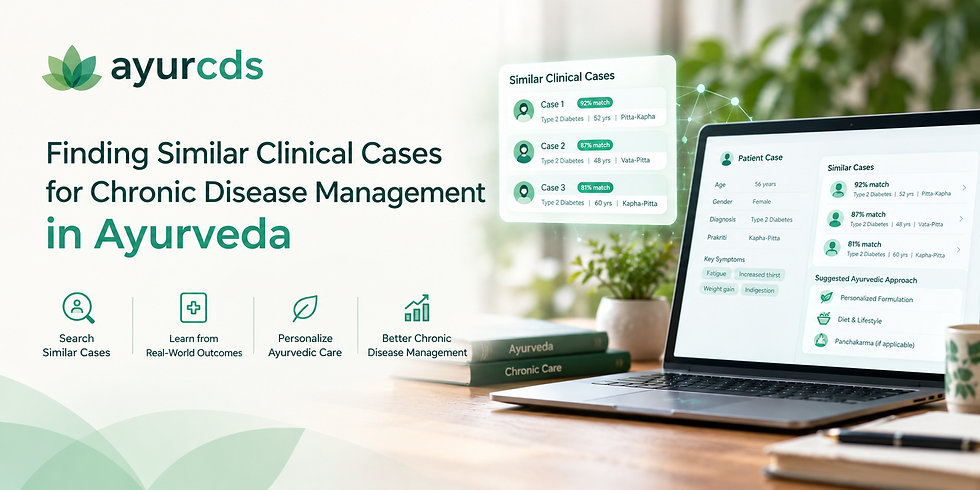
Some are now turning to case-based clinical decision support, where real-world Ayurvedic cases offer guidance, not rules.
Platforms like AyurCDS allow doctors to review how similar cases were approached and how patients responded over time — helping them think more clearly at the point of care.
How Doctors Validate Ayurvedic Treatment Choices in Practice
Validation in Ayurveda doesn’t come from checklists or lab values alone.
It comes from:
Symptom progression
Patient-reported improvement
Objective and subjective balance
But this validation often stays in the doctor’s head.
What changes when clinical experience becomes structured?
Doctors can:
Compare outcomes across similar cases
Learn what adjustments worked
Strengthen confidence in difficult decisions
Instead of asking “Is this correct?”, the question becomes:
“Has this worked in comparable real-world cases?”
That shift alone makes clinical practice more confident and defensible.
Consistency Doesn’t Mean Standardization
One of the biggest fears among Ayurvedic clinicians is losing personalization.
But consistency doesn’t mean prescribing the same medicines. It means consistent clinical reasoning.
When doctors have access to:
Documented case pathways
Outcome-linked treatments
Shared experiential knowledge
They reduce unnecessary variability — especially in complex or chronic cases.
Clinical decision support systems like AyurCDS help clinics and institutions:
Train junior doctors better
Reduce uncertainty in similar presentations
Build collective clinical wisdom over time
A Quiet Evolution in Ayurvedic Practice
This isn’t a loud revolution.
There are no rigid guidelines. No automation replacing judgment.
Instead, there’s a subtle shift:
From isolated experience → shared learning
From memory-based practice → experience-supported decisions
From uncertainty → informed confidence
AyurCDS fits into this space as a doctor assistant, not a decision-maker.
Why This Moment Matters for Ayurveda
Ayurveda has always been individualized, observational, and outcome-driven.
What’s new is the ability to capture, organize, and learn from clinical experience at scale.
As patient expectations rise and cases grow more complex, tools that support better decision-making will become essential — not optional.
Ayurveda doesn’t need rigid protocols. It needs better support for clinical reasoning.
That’s the gap platforms like AyurCDS are designed to fill.


Comments