
How Ayurvedic Doctors Decide the Right Treatment in Complex Cases — And How They Validate Their Choices

Updated: 4 days ago

Modern Ayurvedic practice is no longer limited to straightforward, single-system disorders. Today’s clinicians increasingly manage complex, chronic, and multi-factor cases, often with patients who expect clear reasoning and outcome justification.
This raises two critical clinical questions:
How can Ayurvedic doctors decide the right treatment protocols in complex cases?
How do Ayurvedic doctors validate their treatment choices with confidence?
This article explores how experienced practitioners approach these challenges using structured clinical reasoning, case comparison, and evidence-based decision support.
1. How Can Ayurvedic Doctors Decide the Right Treatment in Complex Cases?
Why Complex Cases Are Different
Complex Ayurvedic cases often involve:
Multiple overlapping symptoms
Mixed doshic involvement
Chronic disease progression
Prior treatment exposure
Variable patient compliance
In such cases, textbook prescriptions or memory-based recall are often insufficient.
A Clinically Practical Decision-Making Framework
Experienced Ayurvedic physicians typically rely on a three-layer decision process rather than a single protocol.
Classical Clinical Assessment (Foundation)
This includes:
Prakriti–Vikriti analysis
Nidana–Samprapti understanding
Rogi Bala and Roga Bala assessment
This layer defines what is possible within Ayurvedic principles.
Case Comparison (Pattern Recognition)
Instead of treating every case in isolation, doctors ask:
Have I seen similar cases before?
Which treatments worked, failed, or required modification?
What patterns emerged across outcomes?
This mental case comparison is powerful — but limited by human memory.
Evidence Integration (Reducing Uncertainty)
Evidence in Ayurveda is increasingly derived from:
Published case reports
Observational studies
Real-world clinical outcomes
When this evidence is structured and searchable, it helps refine treatment selection, especially in borderline or ambiguous cases.
This is where clinical decision support systems play a growing role.
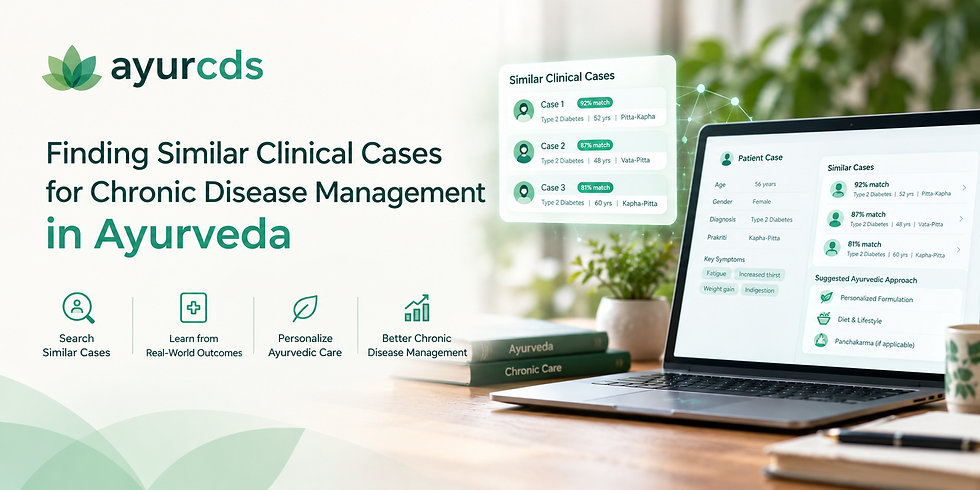
Platforms like AyurCDS assist doctors by organizing clinical evidence and comparable cases, enabling more confident, context-specific treatment decisions at the point of care.
2. How Do Ayurvedic Doctors Validate Their Treatment Choices?
Why Validation Matters More Than Ever
Today’s patients frequently ask:
“Why this treatment?”
“What makes this protocol suitable for my case?”
“Is there evidence this approach works?”
Validation is no longer only internal — it is part of patient communication and professional accountability.
Three Ways Ayurvedic Doctors Validate Treatments
1.Experiential Validation
Based on personal clinical experience
Relies on pattern recall over time
While valuable, this approach is:
Difficult to explain externally
Hard to standardize
Prone to bias in complex cases
2.Textual & Research-Based Validation
Classical Ayurvedic references
Modern clinical studies
This adds credibility but often:
Lacks real-world complexity
Is difficult to apply directly during consultation
3.Real-World Evidence Validation (Most Practical)
Real-world evidence focuses on:
Outcomes in similar patient profiles
Treatment responses across comparable cases
Contextual factors affecting results
Digital platforms like AyurCDS enable this by:
Structuring anonymized clinical cases
Highlighting outcome trends
Supporting explainable treatment reasoning
This allows doctors to confidently state:
“Based on comparable cases and observed outcomes, this approach has shown consistent clinical benefit.”
Evidence-Based Ayurveda Is an Evolution, Not a Replacement
Evidence-based practice in Ayurveda does not replace:
Classical texts
Clinical intuition
Individualized care
Instead, it:
Reduces uncertainty in complex cases
Improves consistency of outcomes
Strengthens patient trust
Supports reflective clinical practice
Clinical decision support acts as an assistant to the physician’s reasoning, not an automated decision-maker.
How AyurCDS Supports Ayurvedic Doctors in Real Practice
AyurCDS is an evidence-based clinical decision support system for Ayurveda, designed specifically for consultation-time reasoning.
It helps doctors:
Compare complex cases with prior clinical evidence
Understand treatment outcomes in similar profiles
Validate decisions with structured, explainable data
Integrate classical reasoning with real-world insights


Comments