
How Structured Clinical Data Improves Treatment Outcomes in Ayurveda

Updated: Jul 26

Imagine two Ayurvedic doctors treating patients with the same condition.
Both are knowledgeable. Both follow classical Ayurvedic principles. Both genuinely want the best outcome for their patients.
Yet one doctor has access to thousands of well-documented clinical cases, searchable treatment outcomes, and organized evidence from years of practice, while the other relies mainly on memory, handwritten notes, and scattered references.
Who is likely to make faster, more informed clinical decisions?
The answer is obvious.
The difference isn't clinical skill—it's access to structured clinical knowledge.
As Ayurveda enters the digital era, structured clinical data is becoming one of the most valuable resources for improving patient care. It allows practitioners to learn not only from classical texts but also from real-world clinical experience documented in a consistent, searchable format.
What Is Structured Clinical Data?
Structured clinical data is information that follows a standardized format instead of being stored as unorganized notes or lengthy paragraphs.
Rather than recording only free-text observations, clinical information is organized into clearly defined fields that can be searched, compared, and analyzed.
Examples include:
Patient demographics
Prakriti
Vikriti
Dosha predominance
Agni status
Diagnosis
Chief complaints
Nidana
Samprapti
Medicines prescribed
Panchakarma procedures
Diet and lifestyle advice
Follow-up observations
Clinical outcomes
When thousands of patient records follow the same structure, valuable clinical insights become much easier to identify.
Why Traditional Documentation Has Limitations
Most Ayurvedic practitioners maintain excellent clinical notes.
However, these records often exist as:
Handwritten case sheets
Individual notebooks
Word documents
PDFs
Spreadsheets
Hospital records
Personal observations
The information is available—but it is difficult to retrieve when needed.
For example, imagine trying to answer questions like:
How many patients with rheumatoid arthritis responded well to a specific treatment approach?
Which formulations produced the best outcomes in chronic psoriasis?
Which Panchakarma procedures were commonly used in lumbar spondylosis?
What treatment combinations worked best for recurrent migraine?
Without structured data, finding these answers requires manually reviewing hundreds of patient records.
Structured Data Makes Clinical Knowledge Searchable
One of the greatest advantages of structured clinical data is that it transforms individual patient records into a valuable knowledge resource.
Instead of searching through files one by one, doctors can quickly identify:
Similar clinical cases
Frequently used treatment plans
Disease-specific management approaches
Documented outcomes
Follow-up patterns
Supporting evidence
This enables faster access to relevant clinical knowledge during patient consultations.
Better Clinical Decisions Through Pattern Recognition
Experienced physicians naturally recognize patterns.
After treating hundreds of patients, they begin noticing which approaches work well under different circumstances.
Structured clinical data extends this ability.
When clinical information from many practitioners is organized consistently, it becomes possible to identify patterns across thousands of cases.
For example:
Which herbal combinations are commonly used for a particular presentation?
How does treatment vary according to Dosha predominance?
Which interventions are associated with better follow-up outcomes?
Are certain treatment strategies consistently used for specific patient groups?
These insights support evidence-informed clinical thinking while respecting the individualized nature of Ayurveda.
Improving Continuity of Care
Many chronic conditions require months of follow-up.
Patients may revisit the clinic after several weeks or even months.
With structured documentation, doctors can quickly review:
Previous complaints
Earlier prescriptions
Lifestyle recommendations
Panchakarma history
Clinical progress
Treatment response
This improves continuity of care and reduces the chances of overlooking important clinical details.
Supporting Research and Evidence Generation
Ayurveda has a rich clinical tradition, but much of its knowledge remains scattered and difficult to analyze.
Structured clinical data changes this.
When patient information is standardized, it becomes easier to:
Conduct retrospective studies
Generate real-world evidence
Identify successful treatment trends
Publish clinical case series
Support evidence-informed practice
Improve clinical education
Over time, this contributes to a stronger evidence base for Ayurveda while preserving its individualized approach.
Better Learning for Young Practitioners
New graduates often ask experienced physicians one important question:
"How would you treat this patient?"
Structured clinical databases provide valuable learning opportunities by allowing students and early-career practitioners to study documented clinical cases, treatment strategies, and outcomes.
Rather than learning only from textbooks, they gain exposure to real-world clinical decision-making.
How AyurCDS Uses Structured Clinical Data
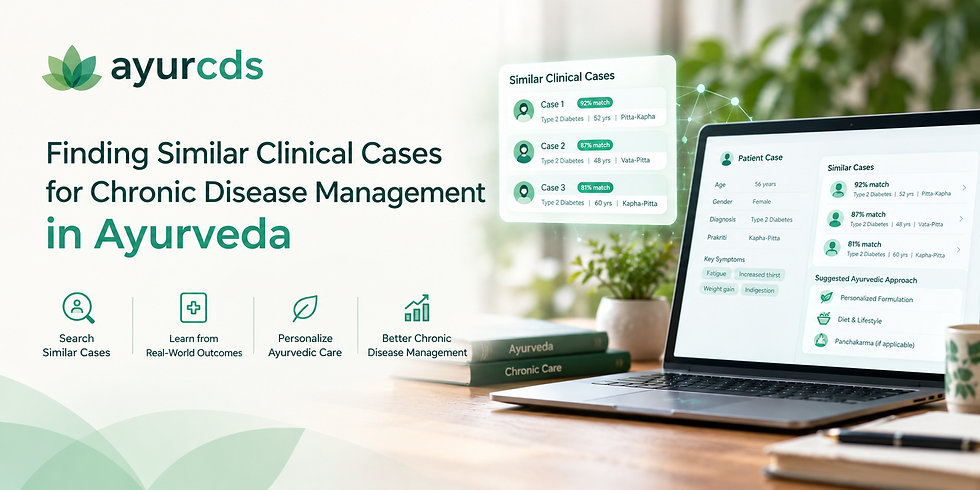
AyurCDS is designed around the idea that clinical knowledge becomes more valuable when it is organized and searchable.
Instead of storing information as isolated documents, AyurCDS helps structure clinical information so doctors can quickly locate relevant knowledge.
The platform enables practitioners to:
Search similar clinical cases
Review documented treatment approaches
Explore disease-specific clinical information
Access published case reports
Find relevant research literature
Retrieve evidence-informed clinical knowledge
By reducing the time spent searching for information, doctors can focus more on patient care and thoughtful clinical reasoning.
Structured Data Supports—Not Replaces—Clinical Judgment
Some people assume that structured data means standardized treatment protocols.
That is not how Ayurveda works.
Every patient is unique.
Clinical decisions must always consider:
Prakriti
Dosha imbalance
Agni
Bala
Age
Disease stage
Mental state
Lifestyle
Environmental factors
Structured clinical data simply provides better access to relevant knowledge.
The physician remains responsible for interpreting that information and choosing the most appropriate treatment.
The Future of Ayurveda Is Data-Driven and Patient-Centered
Healthcare worldwide is increasingly using structured clinical information to improve quality, safety, and research.
Ayurveda can benefit from the same approach while preserving its holistic philosophy.
As more practitioners document clinical information in standardized formats, the profession gains:
Better knowledge sharing
Faster learning
Stronger research
Improved clinical consistency
Better treatment evaluation
Enhanced patient care
Structured clinical data does not replace traditional wisdom—it strengthens it by making valuable clinical experience easier to discover and apply.
Frequently Asked Questions
What is structured clinical data in Ayurveda?
Structured clinical data is patient information recorded using standardized fields such as diagnosis, Prakriti, Dosha, treatment, follow-up, and outcomes. This organization makes the information easier to search, analyze, and use in clinical practice.
How does structured data improve treatment outcomes?
It helps doctors quickly identify relevant clinical cases, review successful treatment approaches, monitor patient progress, and learn from documented clinical experience, leading to more informed decision-making.
Does structured clinical data replace Ayurvedic principles?
No. Structured data supports Ayurvedic practice by improving access to clinical knowledge. Diagnosis and treatment decisions remain based on classical principles and the physician's expertise.
How does AyurCDS use structured clinical data?
AyurCDS organizes clinical knowledge, case studies, and evidence-informed resources into a searchable platform, enabling Ayurvedic doctors to access relevant information quickly during clinical practice.


Comments