
How to Modernize an Ayurvedic Clinic: A Practical Guide to Digital Tools


Ayurveda has always emphasized individualized healthcare through classical principles such as Prakriti, Dosha balance, Agni, Dhatu, and personalized Chikitsa. However, as patient expectations evolve and clinical practices become more complex, Ayurvedic practitioners face a growing need to modernize how they manage information, evaluate treatment options, and monitor patient outcomes.
Modernizing an Ayurvedic clinic does not mean replacing traditional knowledge with technology. It means using appropriate digital tools to strengthen clinical reasoning, improve access to relevant information, streamline practice workflows, and support more informed healthcare decisions.
From digital patient documentation and clinic-management systems to Ayurveda-specific Clinical Decision Support Systems (CDSS), technology can help practitioners build more organized, efficient, and evidence-informed practices.
This guide explores six practical ways to modernize an Ayurvedic clinic while preserving the core principles of traditional Ayurveda.
Why Do Ayurvedic Clinics Need to Modernize?
Many Ayurvedic clinics continue to depend on paper-based records, manual documentation, and individual practitioner experience to manage patient information and treatment decisions.
Although these approaches have supported traditional practice for generations, they can create challenges as patient volumes increase and clinical cases become more complex.
Some common challenges include:
Fragmented patient information: Paper records make it difficult to retrieve historical consultations, diagnostic observations, and treatment details.
Limited access to clinical evidence: Practitioners may find it difficult to identify comparable cases, review published treatment experiences, and evaluate clinical outcomes.
Difficulty monitoring long-term outcomes: Tracking patient progress across multiple consultations and treatment cycles can become cumbersome.
Administrative workload: Manual appointment management, billing, inventory, and therapy scheduling consume valuable time.
Limited research readiness: Unstructured clinical information is difficult to analyze, compare, and use for generating real-world evidence.
Patients also increasingly expect convenient appointments, accessible communication, and continuity of care.
Modernization addresses these challenges by combining Ayurveda-specific digital tools, efficient workflows, and clinical knowledge resources.
1. Digitize Patient Records Using Ayurveda-Specific Documentation Tools
Digital patient documentation is an important foundation for modern Ayurvedic practice.
Generic Electronic Medical Record (EMR) systems may not adequately represent the diagnostic and therapeutic concepts used in Ayurveda. Parameters such as Prakriti, Vikriti, Dosha assessment, Agni, Ama, Srotas involvement, and other classical observations require an Ayurveda-oriented documentation approach.
A suitable digital documentation system should support:
Structured recording of patient history and clinical observations.
Prakriti and Vikriti assessment.
Documentation of Dosha, Agni, Ama, and other relevant diagnostic parameters.
Recording of Shamana and Shodhana treatment approaches.
Panchakarma procedures and associated treatment protocols.
Follow-up observations and longitudinal outcome tracking.
Secure information storage and appropriate access controls.
Organized digital records improve continuity between consultations and make historical patient information easier to retrieve.
Over time, structured and appropriately anonymized clinical data can also support case reviews, observational research, and institutional knowledge development.
2. Introduce Ayurveda Clinical Decision Support for Better-Informed Treatment Decisions
Digitizing patient records improves information management, but it does not necessarily help practitioners evaluate clinical evidence or explore treatment approaches for complex cases.
This is where Clinical Decision Support Systems (CDSS) become important.
Ayurvedic practitioners frequently encounter cases where classical references, published research, clinical experience, and individual patient characteristics need to be considered together.
Finding relevant information during a consultation can be challenging, particularly when dealing with chronic conditions, recurring symptoms, or patients who have not responded adequately to previous treatments.
An Ayurveda-specific Clinical Decision Support System can help bridge this gap.
For example, a platform such as AyurCDS provides clinical knowledge resources designed to support evidence-informed Ayurvedic practice through:
Curated clinical case repositories: Access to relevant case reports and documented clinical experiences from research publications and other knowledge sources.
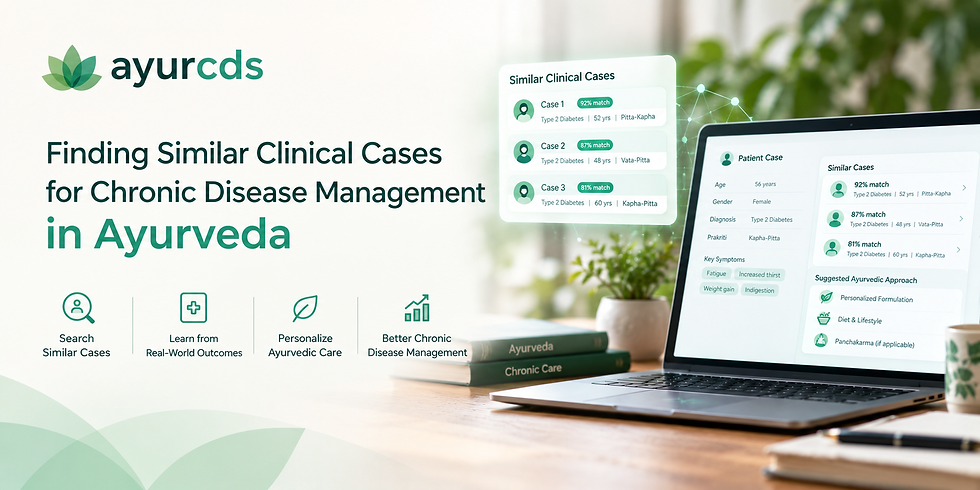
Similar-case exploration: Identify clinically relevant cases based on available parameters such as condition, age, and other patient characteristics.
Treatment insights: Review documented treatment approaches, classical references, and reported outcomes from comparable cases.
Point-of-care knowledge access: Explore relevant clinical information while evaluating a patient's condition.
Evidence-informed reasoning: Bring together classical Ayurvedic knowledge, published research, clinical observations, and practitioner expertise.
The objective is not to automate Ayurvedic diagnosis or prescribe treatments. It is to help practitioners access relevant clinical knowledge, examine comparable experiences, and make more informed decisions.
AyurCDS functions as a clinical intelligence layer alongside existing EMR and clinic-management systems. It focuses on the clinical knowledge and decision-support aspects of practice rather than replacing administrative or patient-management software.
For Ayurvedic doctors, this creates an opportunity to move beyond relying exclusively on individual experience by incorporating structured clinical knowledge and documented treatment outcomes into their reasoning process.
3. Streamline Clinic Management and Everyday Workflows
Clinical knowledge is only one aspect of running a modern Ayurvedic clinic. Efficient administrative processes are equally important.
Clinic-management software can reduce repetitive tasks and help practitioners and support staff coordinate daily activities.
Important capabilities include:
Online appointment booking and automated reminders through SMS or WhatsApp.
Digital billing and payment management.
Inventory tracking for medicinal herbs, oils, and Panchakarma materials.
E-prescriptions and digital treatment instructions.
OPD queue management.
Scheduling of multi-day Panchakarma therapies and follow-up visits.
Staff coordination and workflow management.
These capabilities help reduce administrative overhead and allow practitioners to dedicate more time to patient consultations.
Clinics should also establish standard operating procedures for documentation, hygiene, therapy safety, and patient communication. These processes become increasingly important when expanding to multiple practitioners or treatment facilities.
4. Improve Patient Experience Through Digital Engagement
A modern Ayurvedic clinic should make it easier for patients to access care, understand treatment recommendations, and maintain continuity between consultations.
Digital engagement tools can improve communication and make personalized healthcare guidance more accessible.
Some practical approaches include:
Teleconsultation and follow-ups
Offer online consultations where clinically appropriate, particularly for follow-up discussions, lifestyle guidance, and monitoring treatment progress.
Personalized Ayurvedic recommendations
Share individualized dietary guidance (Ahara), daily routines (Dinacharya), lifestyle recommendations, and treatment instructions in accessible digital formats.
Patient communication
Use appropriate digital communication channels to share appointment reminders, follow-up instructions, and relevant educational resources.
Online visibility
Maintain a professional website, an updated Google Business Profile, practitioner information, and educational content that helps patients understand the clinic's approach to Ayurveda.
Progress monitoring
Encourage structured follow-ups to evaluate patient-reported improvements, treatment responses, and changes in relevant clinical observations.
The goal is to create a more accessible and consistent patient experience without compromising the personalized nature of Ayurvedic treatment.
5. Build an Evidence-Informed Ayurvedic Practice
One of the most important opportunities in modern Ayurvedic healthcare is the systematic use of clinical experience and available research evidence.
Evidence-based Ayurveda should not be restricted to reading research papers. Clinical reasoning involves considering multiple sources of knowledge:
Classical Ayurvedic references and established principles.
Published research and scientific literature.
Documented case reports and clinical experiences.
Treatment responses and outcomes observed over time.
Individual patient characteristics, preferences, and context.
However, these sources are often scattered across journals, publications, institutional repositories, and individual clinical records.
Modern clinical knowledge platforms can help practitioners discover, organize, and evaluate relevant information more efficiently.
Clinics can strengthen evidence-informed practice by:
Reviewing relevant clinical literature and documented case experiences.
Conducting periodic reviews of complex or recurring cases.
Tracking treatment responses and patient-reported outcomes.
Identifying patterns across appropriately anonymized clinical observations.
Encouraging knowledge sharing and clinical discussions among practitioners.
This approach creates a continuous learning cycle in which clinical experience informs practice, documented outcomes contribute to collective knowledge, and available evidence supports better-informed decisions.
Over time, these efforts can also create opportunities for research collaboration and the development of structured real-world evidence in Ayurveda.
6. Train Your Team and Adopt a Phased Digital Transformation Strategy
Introducing multiple digital tools simultaneously can overwhelm practitioners and clinic staff.
A phased approach makes modernization more practical and sustainable.
Phase 1: Establish the digital foundation
Introduce Ayurveda-specific digital patient documentation.
Organize existing patient information.
Digitize appointment and billing workflows where required.
Phase 2: Strengthen clinical decision-making
Introduce Ayurveda Clinical Decision Support tools.
Explore curated clinical case repositories.
Establish structured follow-up and outcome-monitoring practices.
Encourage evidence-informed clinical discussions.
Phase 3: Improve patient engagement and operational efficiency
Introduce teleconsultation where appropriate.
Implement digital patient communication.
Improve inventory and therapy scheduling workflows.
Explore analytics and research-oriented capabilities.
Staff training is essential throughout this process. Physicians, therapists, and administrative personnel should understand how each tool fits into their responsibilities.
Most importantly, technology should support classical Ayurvedic reasoning and practitioner expertise, not replace them.
Key Benefits of Modernizing an Ayurvedic Clinic
A well-planned digital transformation can deliver several benefits:
Improved clinical information access: Retrieve relevant patient history and clinical knowledge more efficiently.
Better continuity of care: Maintain organized information across consultations and follow-ups.
More informed clinical decisions: Access relevant research, documented cases, and treatment experiences.
Reduced administrative workload: Automate repetitive operational activities.
Improved patient experience: Provide more convenient communication and follow-up processes.
Research readiness: Build structured clinical information that can support future research and knowledge sharing.
Scalability: Establish standardized workflows for growing clinics, multi-practitioner centers, and Ayurvedic hospitals.
The real value of modernization lies in combining operational efficiency with stronger clinical knowledge access.
How AyurCDS Supports the Modernization of Ayurvedic Clinical Practice
Modernizing an Ayurvedic clinic requires more than adopting appointment-booking applications or digitizing patient records. Practitioners also need access to relevant clinical knowledge that can support their reasoning at the point of care.
This is the specific gap AyurCDS addresses.
AyurCDS is an Ayurveda Clinical Decision Support System designed to help Ayurvedic practitioners access clinical knowledge, explore comparable cases, and strengthen evidence-informed decision-making.
The platform focuses on:
Curated clinical case studies and research resources.
Exploration of similar clinical cases.
Access to documented treatment approaches and outcomes.
Clinical knowledge discovery for complex patient conditions.
Support for integrating classical Ayurvedic principles with available clinical evidence.
Unlike conventional EMR or clinic-management software, AyurCDS focuses on the clinical intelligence layer of Ayurvedic practice.
It is designed to complement existing practice-management systems by helping practitioners access and evaluate clinical knowledge without disrupting their established workflows.
For individual Ayurvedic doctors, clinics, and healthcare institutions, this provides an additional resource for continuous learning and evidence-informed clinical practice.
Explore AyurCDS: https://www.ayurcds.com/
Getting Started: The Future of Digital Ayurveda
Modernizing an Ayurvedic clinic is not about replacing traditional methods with technology. It is about strengthening the way clinical knowledge is accessed, patient information is managed, and treatment outcomes are evaluated.
Clinics can begin by identifying their most pressing challenges—whether they involve fragmented records, administrative workload, limited access to clinical evidence, or difficulty monitoring long-term outcomes.
The next step is to adopt digital tools that address these needs without adding unnecessary complexity.
Digital documentation, clinic-management software, patient engagement tools, and Ayurveda-specific Clinical Decision Support Systems each serve different purposes. Understanding these distinctions helps practitioners build a more effective digital ecosystem.
The future of Ayurvedic healthcare will depend not only on preserving classical knowledge but also on making it more accessible, structured, and applicable to contemporary clinical practice.
By combining the wisdom of Ayurveda with appropriate digital infrastructure and clinical intelligence, practitioners can build more efficient, evidence-informed, and patient-centric Ayurvedic practices.


Comments