
Point-of-Care Clinical Referencing Tools in Ayurveda: Why Google and Textbooks Are No Longer Enough

Updated: Aug 9

Ayurvedic practice has always depended on clinical reasoning, experience, and contextual judgment.Yet modern practice brings new challenges:
Increasing patient complexity
Time pressure in busy OPDs
Growing expectations for evidence
Information overload from the internet
In modern medicine, tools like UpToDate and OpenEvidence emerged to solve a simple problem:
Clinicians don’t have time to search — they need answers at the point of care.
Ayurveda now faces the same challenge.
What Are Point-of-Care Clinical Referencing Tools?
A point-of-care (POC) clinical referencing tool is not a textbook and not a search engine.
It is a system designed to:
Support clinical thinking during consultation
Provide contextual, relevant references
Reduce cognitive load
Improve consistency and confidence in decision-making
In allopathy, tools like UpToDate:
Summarize evidence
Link guidelines to real cases
Continuously update based on research
But Ayurveda works differently.
Why Google, PDFs, and Journals Fail at the Point of Care
Most Ayurvedic doctors today rely on:
Google searches
WhatsApp forwards
Scanned books
Isolated journal articles
These sources suffer from major limitations:
No Clinical Context
Search engines don’t understand:
Prakriti
Vikriti
Bala
Stage of disease
No Case Similarity
They can’t answer:
“What worked in patients like this?”
No Outcome Orientation
They show information, not:
Follow-up
Response patterns
Long-term outcomes
Fragmented Knowledge
Ayurvedic wisdom is split across:
Classical texts
Modern research
Practitioner experience
This fragmentation is exactly what point-of-care tools aim to solve.
Why Ayurveda Needs Its Own UpToDate-Style Tools
Ayurveda cannot simply reuse allopathic CDS systems.
Because Ayurvedic decision-making is:
Personalized
Multi-factorial
Experience-driven
Pattern-based
What Ayurveda needs is not protocol enforcement — but clinical referencing grounded in real practice.
That means:
Learning from documented cases
Preserving reasoning, not just prescriptions
Respecting practitioner autonomy
What a True Ayurvedic Point-of-Care Tool Looks Like
A meaningful POC tool for Ayurveda should:
✔ Be Case-Centered
Instead of abstract theory, it should surface:
Similar patient cases
Comparable conditions
Treatment pathways used in practice
✔ Be Outcome-Aware
Not just what was prescribed, but:
What improved
Over what time
Under what conditions
✔ Support, Not Replace, the Doctor
Like OpenEvidence or UpToDate:
It assists thinking
It doesn’t dictate decisions
✔ Respect Classical Foundations
Clinical references must align with:
Ayurvedic principles
Textual logic
Traditional diagnostics
From Clinical Referencing to Decision Support
There is an important difference between:
Clinical referencing tools (what to look at)
Clinical decision support systems (CDS) (how to think next)
Ayurveda benefits most when these merge.
A CDS-style reference system can:
Highlight relevant past cases
Show treatment trends
Support reasoning at the moment of care
Reduce uncertainty in complex cases
This is exactly where modern Ayurvedic practice is heading.
How AyurCDS Fits This Gap
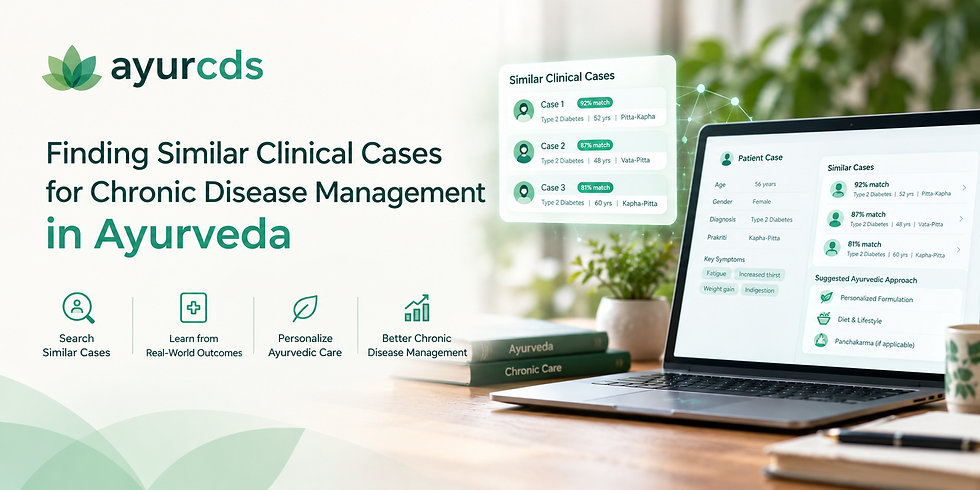
AyurCDS is built specifically to function as a point-of-care clinical referencing and decision support system for Ayurveda.
Instead of acting like a search engine, it focuses on:
Structured Ayurvedic case data
Practice-based evidence
Clinical pattern recognition
Contextual learning from real outcomes
Inspired by systems like UpToDate and OpenEvidence — but designed for Ayurvedic logic — AyurCDS enables:
Faster clinical referencing
Better confidence in case handling
Continuous learning from practice
Stronger foundations for education and research
Importantly, it does this without oversimplifying Ayurveda.
Why This Matters for Practitioners, Students, and Institutions
For Practicing Doctors
Reduces dependence on memory alone
Supports complex decision-making
Encourages reflective practice
For Students & PG Scholars
Accelerates clinical exposure
Bridges theory with real outcomes
Encourages case-based learning
For Ayurveda as a System
Makes evidence visible
Preserves clinical wisdom
Strengthens credibility responsibly
The Future of Ayurvedic Practice Is Point-of-Care Intelligence
Ayurveda does not need more information.
It needs:
Better clinical referencing
Better use of real-world evidence
Better decision support at the point of care
Just as modern medicine evolved from textbooks to intelligent CDS platforms, Ayurveda is now entering a similar phase.
AyurCDS represents this shift — from fragmented knowledge to structured clinical intelligence.
The goal is not to change Ayurveda.The goal is to practice it better, together.


Comments