
Top Ayurvedic Research Tools Every Practitioner Should Know

Updated: 4 days ago

A Practical Guide to Evidence, Clinical Data, and Modern Decision Support in Ayurveda
Ayurveda is evolving. While its foundations remain deeply rooted in classical texts and centuries of clinical wisdom, today’s practitioners face a new reality: healthcare is becoming increasingly evidence-driven, data-oriented, and outcome-focused.
Whether you are a clinician, academic, postgraduate student, or institution, knowing where to find reliable Ayurvedic research evidence is no longer optional. The right tools help you:
Validate clinical decisions
Improve treatment consistency
Support academic writing and research
Build confidence among patients and peers
This article provides a comprehensive, practitioner-friendly overview of the top Ayurvedic research tools—from government portals and journals to modern clinical decision support platforms like AyurCDS.
Why Ayurvedic Research Tools Matter Today
Unlike allopathic medicine, which relies heavily on standardized protocols and randomized controlled trials (RCTs), Ayurveda is:
Personalized
Context-dependent
Multi-intervention based
This makes evidence harder to centralize—but not impossible. Modern research tools help bridge this gap by organizing classical knowledge, experimental research, clinical trials, and real-world case data into usable formats.
The goal is not to replace tradition, but to support evidence-aligned Ayurvedic practice.
1. AYUSH Research Portal
The Government of India’s Central Evidence Repository
What it is:The AYUSH Research Portal is the most authoritative government-backed platform for AYUSH research, including Ayurveda.
What it offers:
Clinical trial data
Drug research and safety profiles
Disease-wise evidence summaries
Preclinical and pharmacological studies
Strengths:
High credibility
Ideal for regulatory, academic, and institutional referencing
Limitations:
Not designed for point-of-care use
Limited clinical interpretation or synthesis
Best for:Researchers, faculty, and practitioners who need official validation and citations.
2. CCRAS Research Publications
Institutional Backbone of Ayurvedic Research
The Central Council for Research in Ayurvedic Sciences (CCRAS) has been conducting and publishing structured Ayurvedic research for decades.
What it offers:
Multi-center clinical trials
Standard treatment guidelines
Disease-specific long-term studies
Strengths:
Methodological rigor
National-level datasets
Limitations:
Mostly PDF-based
Limited searchability and clinical usability
Best for:Academic research, curriculum development, and policy documentation.
3. Peer-Reviewed Ayurvedic Journals
Journal of Ayurveda and Integrative Medicine (JAIM)
One of the most respected Ayurvedic journals globally.
Focus areas:
Evidence-based Ayurveda
Integrative medicine
Research methodology
Why it matters:JAIM bridges Ayurveda with modern scientific discourse, making it valuable for international credibility.
AYU Journal (CCRAS)
Focus areas:
Clinical trials
Drug standardization
Case series
Why it matters:It is an official, indexed journal suitable for formal academic referencing.
Ancient Science of Life
Focus:Applied Ayurveda and practice-linked research.
Why it matters:Useful for connecting classical principles with clinical application.
4. PubMed & Google Scholar (Ayurveda-Filtered Use)
PubMed
Although not Ayurveda-centric, PubMed indexes:
Ayurvedic clinical trials
Systematic reviews
Integrative medicine studies
How to use effectively:
Search by condition + “Ayurveda”
Filter for clinical trials and reviews
Limitations:
Requires interpretation by Ayurvedic experts
Not designed for Ayurvedic diagnostic logic
Google Scholar
Strength: Broad discovery
Limitation: Mixed quality, duplication, lack of curation
Best used as a discovery tool, not a final authority.
5. Clinical Trials Registry of India (CTRI)
What it offers:
Registered Ayurvedic clinical trials
Ongoing and completed studies
Strengths:
Mandatory registration ensures transparency
Limitations:
No outcome synthesis
No clinical recommendations
Best for:Identifying research trends and evidence gaps.
6. Classical Text Digitization Tools
Foundational but Not Outcome-Based
Digital libraries of:
Charaka Samhita
Sushruta Samhita
Ashtanga Hridaya
Strengths:
Conceptual and philosophical authority
Limitations:
No clinical outcome data
Not evidence in the modern sense
These tools provide foundational reasoning, not measurable evidence.
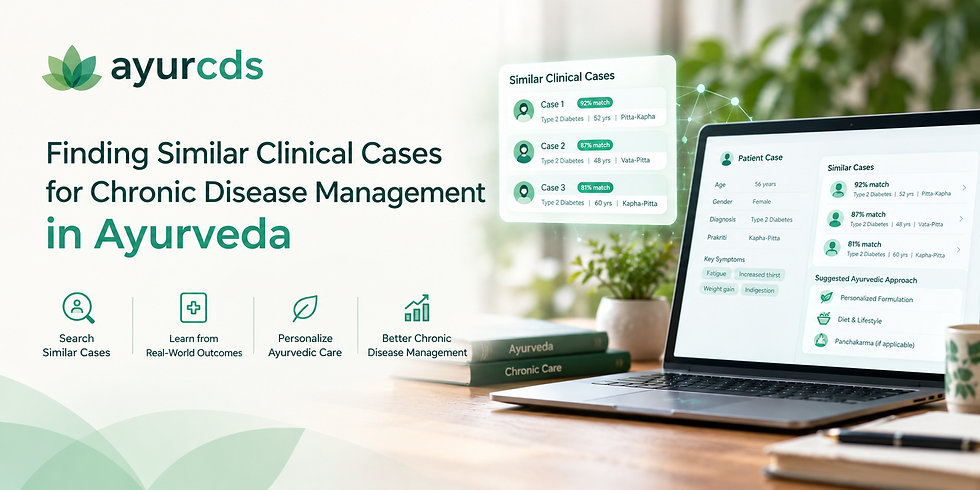
7. AyurCDS – Modern Clinical Decision Support for Ayurveda
AyurCDS represents the next generation of Ayurvedic research tools.
What makes AyurCDS unique:
Structured clinical case repository
Prakriti–vikriti based categorization
Treatment pathways with observed outcomes
Searchable, comparable, and reusable data
Unlike journals or portals, AyurCDS focuses on real-world clinical practice.
Why practice-based evidence matters in Ayurveda
Treatments are individualized
Outcomes unfold over time
Multiple interventions act together
RCTs alone cannot capture this complexity. AyurCDS converts daily clinical experience into structured evidence.
Best for:
Practicing clinicians
Postgraduate students
Teaching institutions
Evidence-aligned practice
Comparing Ayurvedic Research Tools by Use Case
Tool | Evidence Type | Clinical Use | Academic Use |
AYUSH Portal | Trials, drug data | Low | High |
CCRAS | Institutional studies | Low | High |
Journals | Peer-reviewed | Medium | High |
PubMed | Global trials | Medium | High |
CTRI | Trial registry | Low | Medium |
AyurCDS | Practice-based evidence | High | Medium |
The Bigger Picture: Ayurveda Needs a Multi-Layered Evidence Model
Ayurveda cannot depend on:
RCTs alone
Single-drug studies
Isolated publications
It requires:
Structured case documentation
Pattern recognition across patients
Context-aware clinical reasoning
Modern research tools—especially platforms like AyurCDS—do not replace classical texts or trials. They complete the evidence ecosystem.
Conclusion: Choosing the Right Tools for Modern Ayurvedic Practice
Every Ayurvedic practitioner should be familiar with:
Government portals for credibility
Journals for academic rigor
Trial registries for transparency
Clinical decision support systems for real-world practice
The future of Ayurveda lies in evidence that is structured, accessible, and clinically meaningful—without compromising its individualized nature.
Ayurveda already has evidence. What it needs is organization, accessibility, and point-of-care intelligence. That is where modern tools—and AyurCDS—play a defining role.


Comments