
What Software Tools Are Useful for Ayurvedic Doctors in Clinics?

Updated: Aug 9

A Practical Guide to Modern, Evidence-Based Ayurvedic Practice
Ayurvedic practice is undergoing a silent transformation.
Today’s Ayurvedic doctor is expected not only to diagnose and treat—but also to document outcomes, justify treatment choices, manage clinics efficiently, and stay clinically updated. As patient expectations rise and cases become more complex, software tools are becoming an essential part of modern Ayurvedic clinics.
This article explores the most useful software tools for Ayurvedic doctors, how they support daily clinical work, and why clinical decision support platforms like AyurCDS are emerging as a cornerstone of evidence-based Ayurvedic practice.
Why Software Tools Matter in Ayurvedic Clinics Today
Traditional Ayurvedic knowledge remains foundational. However, day-to-day practice now involves:
Managing large volumes of patient data
Tracking long-term chronic cases
Explaining treatment logic to informed patients
Demonstrating outcomes and consistency
Learning from real-world clinical experience
Software tools help bridge the gap between classical wisdom and modern clinical expectations—without replacing physician judgment.
1. Electronic Medical Records (EMR) for Ayurveda
What They Do
Ayurveda-specific EMR systems help doctors record:
Prakriti and Vikriti assessments
Dosha imbalances
Treatment protocols
Medicines, Panchakarma, and follow-ups
Why They Are Useful
Faster documentation during consultations
Better continuity of care
Easy retrieval of patient history
Structured clinical records for audits or research
Limitations
Most EMRs focus on recording data, not supporting clinical decision-making.
2. Practice Management & Clinic Operations Software
Key Functions
Appointment scheduling
Billing and invoicing
Inventory management (Ayurvedic medicines)
Staff coordination
Benefits
Reduces administrative workload
Improves patient experience
Enables doctors to focus more on clinical care
These tools are essential for efficiency—but they do not guide clinical decisions.
3. Ayurvedic Reference & Research Platforms
Common Uses
Searching classical texts
Accessing journals, theses, and studies
Looking up formulations and indications
Challenges
Time-consuming during consultations
Lack of case-level applicability
Difficult to translate references into patient-specific decisions
Doctors often know what exists—but struggle to apply it in real-time.
4. Digital Tools for Case Documentation & Follow-Up
What They Support
Longitudinal tracking of symptoms
Outcome measurement
Treatment modifications over time
These tools are especially helpful for:
Chronic diseases
Lifestyle disorders
Multi-system conditions
However, without analytics or comparison, learning remains individual and fragmented.
5. Clinical Decision Support Systems (CDSS) for Ayurveda
The Most Clinically Transformative Category
This is where modern Ayurvedic clinics see the greatest impact.
What Is a Clinical Decision Support System?
A CDSS helps doctors:
Analyze complex cases
Compare similar patient profiles
Validate treatment protocols
Access evidence during consultation
Instead of relying solely on memory or scattered references, doctors receive structured, contextual insights.
AyurCDS: A Purpose-Built Clinical Decision Support System for Ayurveda
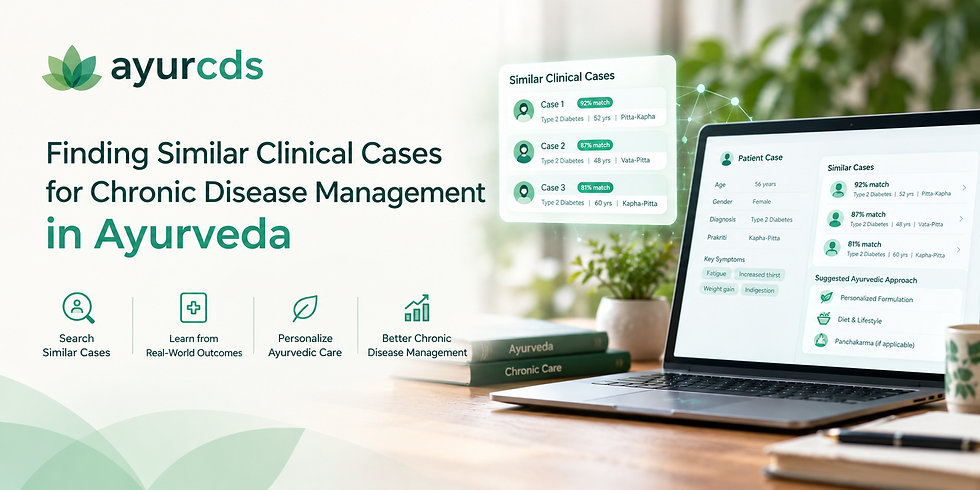
AyurCDS is designed specifically to support consultation-time decision-making in Ayurveda.
What Makes AyurCDS Different?
Unlike EMRs or reference libraries, AyurCDS focuses on:
Case comparison rather than static text
Real-world evidence rather than isolated studies
Clinical reasoning support, not treatment automation
Key Capabilities
Explore similar clinical cases
Understand what treatments worked in comparable contexts
Support evidence-based validation of treatment choices
Improve confidence in complex decision-making
AyurCDS acts as a digital clinical assistant, complementing the doctor’s expertise.
Why Ayurvedic Doctors Are Adopting Decision Support Tools
Doctors using structured decision support report:
Reduced uncertainty in complex cases
Better explanation of treatment choices to patients
More consistent outcomes
Faster clinical learning
Most importantly, these tools help move Ayurveda toward clinically meaningful evidence-based practice—without diluting tradition.
How Software Tools Work Best Together in Clinics
A modern Ayurvedic clinic typically uses:
EMR software → for documentation
Practice management tools → for operations
Reference platforms → for learning
Clinical decision support systems (like AyurCDS) → for real-time clinical reasoning
Each tool serves a distinct purpose—but decision support is where clinical value is maximized.
The Future of Software in Ayurvedic Practice
The next phase of Ayurveda will not be defined by digitization alone—but by intelligent use of clinical data.
Software tools that:
Learn from real-world cases
Support explainable decisions
Respect Ayurvedic principles
will shape how Ayurveda is practiced, taught, and trusted globally.
Final Thoughts
Software tools are no longer optional for Ayurvedic clinics aiming for:
Clinical consistency
Patient trust
Scalable learning
Evidence-supported care
Among these tools, clinical decision support platforms like AyurCDS represent the most meaningful advancement—helping Ayurvedic doctors practice with clarity, confidence, and credibility.


Comments