
Where Do Ayurvedic Doctors Find Reliable Clinical Evidence? A Guide to Evidence-Based Ayurveda Resources

Updated: Jul 26

Modern Ayurvedic practice requires more than classical knowledge alone. Every day, practitioners encounter patients with complex conditions, multiple comorbidities, and evolving healthcare expectations. While classical Ayurvedic texts remain the foundation of practice, clinicians also benefit from access to contemporary research, documented clinical experiences, and structured clinical knowledge.
This raises an important question:
Where can Ayurvedic doctors find reliable clinical evidence to support everyday patient care?
This guide explores the most valuable evidence-based Ayurveda resources and how digital clinical knowledge platforms such as AyurCDS help practitioners access clinically relevant information more efficiently.
What Does Evidence-Based Ayurveda Mean?
Evidence-based Ayurveda does not replace the principles of Ayurveda. Instead, it combines three essential components:
Classical Ayurvedic knowledge
Clinical expertise and practitioner experience
Contemporary scientific and clinical evidence
Together, these sources help clinicians make informed, patient-centered decisions while preserving Ayurveda's individualized approach.
Why Finding Reliable Clinical Evidence Is Challenging
Unlike many conventional medical specialties, Ayurvedic knowledge is distributed across multiple sources.
Doctors often need to consult:
Classical Ayurvedic texts
Peer-reviewed journals
Published case reports
Clinical practice guidelines
Conference proceedings
Government publications
Institutional protocols
Personal clinical experience
Searching across numerous resources can be time-consuming, especially during busy clinical practice.
Common challenges include:
Information scattered across multiple websites
Difficulty locating relevant clinical studies
Limited indexing of Ayurveda literature
Variations in terminology
Lack of searchable case repositories
Time required to review large volumes of literature
Reliable Sources of Clinical Evidence in Ayurveda
1. Classical Ayurvedic Literature
Foundational texts continue to guide diagnosis and treatment.
Examples include:
Charaka Samhita
Sushruta Samhita
Ashtanga Hridaya
Madhava Nidana
Bhavaprakasha
These texts provide principles of diagnosis, pathology, therapeutics, and patient management that remain central to Ayurvedic practice.
2. Peer-Reviewed Research Journals
Research publications help practitioners understand contemporary evidence regarding Ayurvedic interventions.
Useful information includes:
Clinical trials
Systematic reviews
Observational studies
Integrative medicine research
Safety studies
Pharmacological investigations
Peer-reviewed literature contributes to evidence-informed decision-making and supports continuous professional development.
3. Published Case Reports
Individual case reports provide valuable insights into real-world clinical practice.
They may include:
Rare presentations
Complex cases
Treatment strategies
Follow-up observations
Clinical outcomes
Although individual reports are lower in the evidence hierarchy than systematic reviews, collectively they represent an important source of clinical learning.
4. Government and Institutional Resources
Government organizations, research councils, and academic institutions publish valuable information including:
Standard treatment guidelines
Research reports
Disease management recommendations
Public health initiatives
Educational resources
These publications support evidence-informed clinical practice while promoting standardization where appropriate.
5. Clinical Decision Support Platforms
Digital clinical knowledge systems are becoming increasingly important in healthcare.
Instead of searching multiple resources separately, clinicians can access structured knowledge through integrated platforms.
Clinical decision support systems may include:
Disease summaries
Treatment principles
Case repositories
Literature references
Clinical guidelines
Searchable therapeutic information
These platforms help reduce the time required to locate clinically relevant information.
How AyurCDS Helps Doctors Find Clinical Evidence Faster
AyurCDS is designed as a clinical decision support and knowledge platform for Ayurveda.
Rather than functioning solely as a clinic management application, it helps practitioners access structured clinical knowledge at the point of care.
Key capabilities include:
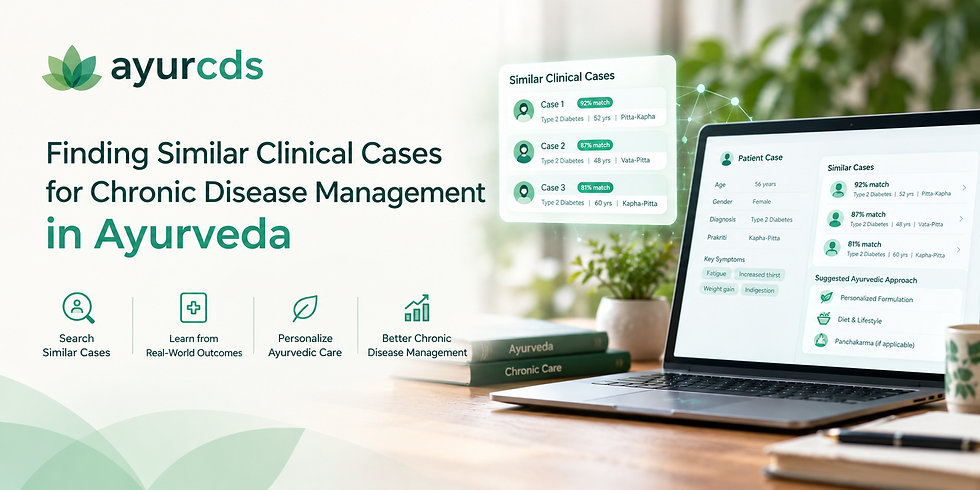
Searchable Clinical Cases
Locate similar cases using:
Disease
Prakriti
Age
Gender
Geographic location
Evidence-Linked Clinical Knowledge
AyurCDS organizes information into structured clinical summaries that connect:
Classical Ayurvedic concepts
Research evidence
Clinical experiences
Therapeutic approaches
This allows practitioners to navigate relevant knowledge more efficiently.
Clinical Knowledge Repository
Instead of storing isolated case reports, AyurCDS transforms clinical information into an organized knowledge base that supports:
Learning
Knowledge sharing
Clinical reasoning
Evidence-informed practice
Faster Information Retrieval
Busy clinicians often have limited time to review lengthy publications.
AyurCDS enables rapid retrieval of clinically relevant information through intelligent search and structured indexing.
Why Searchable Clinical Knowledge Matters
Modern healthcare increasingly depends on organized knowledge rather than isolated documents.
When clinical information becomes searchable, practitioners can:
Compare similar cases
Review documented outcomes
Explore treatment approaches
Identify supporting literature
Learn from previous clinical experiences
Improve consistency in decision-making
This creates a more efficient pathway from knowledge to clinical application.
Building an Evidence-Informed Ayurveda Practice
Evidence-informed practice is not about replacing traditional wisdom with modern research. It is about integrating multiple sources of knowledge to support better clinical decisions.
A balanced approach combines:
Classical principles
Practitioner expertise
Patient preferences
Contemporary research
Real-world clinical evidence
Searchable knowledge systems
This integrated model strengthens both clinical confidence and patient care.
Conclusion
Reliable clinical evidence in Ayurveda comes from a combination of classical texts, peer-reviewed research, published case reports, institutional resources, and carefully documented clinical experience.
The challenge is not the lack of knowledge but the difficulty of finding relevant information quickly when it is needed.
Digital clinical knowledge platforms such as AyurCDS help bridge this gap by transforming dispersed information into a searchable, structured, and clinically useful knowledge base. By integrating classical wisdom with research evidence and real-world clinical experience,
AyurCDS supports evidence-informed decision-making while respecting the foundational principles of Ayurveda.
As Ayurveda continues its digital evolution, searchable clinical knowledge systems will play an increasingly important role in helping practitioners access reliable evidence, improve clinical workflows, and deliver high-quality patient care.


Comments