
Why Case-Based Evidence Matters More Than Guidelines in Ayurveda

Updated: Sep 13

Why This Insight Is Reshaping Evidence-Based Ayurvedic Practice
In modern healthcare, clinical guidelines are treated as the ultimate authority. They tell doctors what to do, when to do it, and how to do it—often backed by years of trials and expert consensus.
But Ayurveda has never worked that way.
For centuries, Ayurvedic medicine has evolved not through rigid protocols, but through careful observation of individual patients, clinical reasoning, and learning from real cases.
As Ayurveda enters the digital age, one truth is becoming increasingly clear:
In Ayurveda, case-based evidence matters far more than standardized guidelines.
Why This Conversation Matters Now
With the rise of medical AI, clinical decision support systems, and evidence platforms inspired by modern medicine, Ayurveda faces a critical challenge.
Should it force itself into guideline-driven frameworks?Or should it preserve what has always made it effective?
This question isn’t academic—it directly impacts how Ayurvedic doctors practice, how evidence is generated, and how the system evolves globally.
Ayurveda Was Always Case-Centric
Ayurvedic diagnosis doesn’t begin with a disease label. It begins with the person.
A single condition may appear similar on paper, but in practice, every patient differs in:
Prakriti and vikriti
Digestive strength (agni)
Chronicity and disease stage
Diet, lifestyle, mental state, and environment
Because of this, two patients rarely receive identical treatment—and that’s not a flaw. It’s the strength of Ayurveda.
Clinical guidelines struggle to accommodate this level of personalization.Case-based evidence captures it naturally.
What Case-Based Evidence Really Means in Ayurveda
Case-based evidence is not anecdotal guesswork.
It includes:
Detailed patient context
Clinical reasoning behind treatment choices
Stepwise treatment evolution
Observed outcomes over time
Traditionally, this knowledge was passed from teacher to student. Today, it can be preserved, analyzed, and shared digitally.
Why Guidelines Fall Short in Ayurvedic Practice
1. Guidelines Assume Uniform Patients
Ayurveda treats patterns, not populations. Guidelines flatten complexity into averages—something Ayurveda actively avoids.
2. Treatment Logic Gets Lost
Ayurvedic care is about why a treatment was chosen, not just what was prescribed. Guidelines rarely capture this reasoning.
3. Multi-Modal Therapies Don’t Fit Well
Herbs, diet, lifestyle changes, and procedures work together. Reducing them to a single recommendation strips away clinical meaning.
4. Long-Term Outcomes Are Ignored
Ayurveda shines in chronic, preventive, and lifestyle-related care—areas where guideline endpoints often fall short.
Real-World Evidence Reflects Real Patients
Most Ayurvedic doctors don’t see “ideal trial patients.”
They see:
Chronic cases
Overlapping complaints
Long disease histories
Lifestyle-driven conditions
Case-based evidence reflects this reality far better than guideline summaries.
Ayurveda Is Pattern-Based, Not Protocol-Based
Experienced practitioners don’t think in checklists.They recognize recurring patterns across cases:
Similar prakriti profiles responding similarly
Seasonal trends influencing outcomes
Repeated success with certain approaches
These insights only emerge when large numbers of real cases are observed and compared.
This is where digital case repositories become powerful.
The Risk of Forcing Ayurveda into Guideline Frameworks
When Ayurveda is judged solely by guideline-based standards, several risks emerge:
Loss of personalization
Oversimplification of treatment
Devaluation of practitioner expertise
Reduced clinical creativity
In trying to appear “modern,” Ayurveda risks losing what makes it effective.
How Digital Tools Can Strengthen Case-Based Evidence
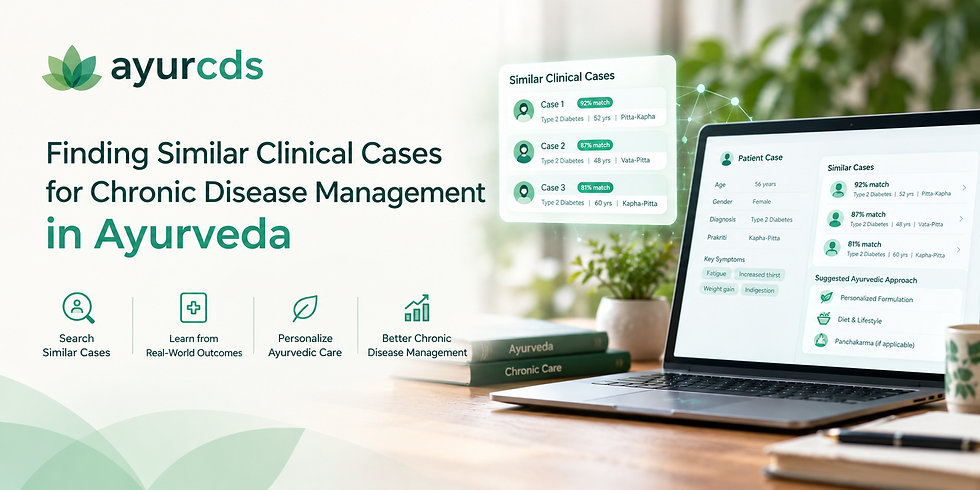
Platforms like AyurCDS are helping Ayurveda evolve without losing its identity.
Instead of replacing clinical judgment, they:
Organize real-world Ayurvedic cases
Preserve practitioner reasoning
Enable comparison across similar cases
Support point-of-care decision-making
The key question shifts from:
“What does the guideline say?”
to:
“What has worked in similar Ayurvedic cases before?”
That shift changes everything.
Case-Based Evidence vs Guidelines: A Simple Truth
Guidelines offer structure.Case-based evidence offers wisdom.
In Ayurveda, wisdom has always driven outcomes.
Evidence-Based Ayurveda Needs a Broader Definition of Evidence
True evidence-based Ayurveda should include:
Classical textual knowledge
Published clinical research
Practice-based, real-world case evidence
Excluding case-based learning weakens the system instead of strengthening it.
The Future of Ayurveda Is Case-Centric
As Ayurveda integrates technology, AI, and digital health platforms, one principle must remain non-negotiable:
Ayurveda advances when it learns from patients, not just protocols.
Case-based evidence is not secondary—it is foundational.
Platforms like AyurCDS demonstrate how tradition and technology can work together to preserve clinical intelligence while enabling modern decision support.
Final Thought
Guidelines may guide—but cases teach.
For Ayurveda to grow, adapt, and remain clinically meaningful in the modern world, it must continue to learn from real patients, real practitioners, and real outcomes.
That is where its future lies.


Comments