
The Growing Complexity of Ayurveda Practice: Why Clinical Reference Apps Have Become Essential

Updated: Jul 26

Ayurveda has always been a knowledge-intensive system of medicine. Every patient is unique, every clinical presentation has its own nuances, and every treatment plan must be tailored to the individual's constitution, disease stage, and overall health.
For generations, Ayurvedic physicians relied on years of study, mentorship, classical texts, and personal clinical experience to make treatment decisions. While these foundations remain as important as ever, the reality of modern clinical practice has changed dramatically.
Today's Ayurvedic doctors are expected to keep up with an expanding body of research, increasing patient expectations, integrative healthcare approaches, and growing volumes of clinical information. Finding the right knowledge at the right time has become more challenging than ever.
This is why clinical reference apps are rapidly becoming an indispensable part of modern Ayurveda practice.
Ayurveda Is Becoming More Complex—Not Less
Contrary to popular belief, digital technology has not simplified clinical practice. In many ways, it has increased the amount of information doctors must process every day.
A practitioner today may need to consider:
Classical Ayurvedic principles
Contemporary clinical research
Published case reports
Panchakarma protocols
Herbal formulations
Lifestyle interventions
Patient comorbidities
Laboratory findings
Integrative treatment approaches
Regional practice variations
Each of these sources adds valuable insight—but together they create an information overload.
The challenge is no longer finding information.
The challenge is finding relevant clinical information quickly.
The Daily Reality of an Ayurvedic Clinic
Imagine seeing 30–50 patients in a busy clinic.
One patient has chronic psoriasis.
The next presents with infertility.
Another has diabetes with neuropathy.
Later in the day, someone arrives with a rare skin disorder you've encountered only once before.
Every consultation demands careful clinical thinking.
Although many answers exist in classical literature or published clinical studies, very few doctors have the time to search through multiple books, PDFs, journals, and websites during a busy outpatient schedule.
As a result, physicians often rely on memory and personal notes—not because they want to, but because accessing information quickly is difficult.

Why Traditional Resources Alone Are No Longer Enough
Classical Ayurvedic texts remain the foundation of clinical practice.
They provide timeless principles that continue to guide diagnosis and treatment.
However, modern practitioners often consult additional resources such as:
Clinical case reports
Research journals
Conference proceedings
Institutional treatment protocols
Continuing medical education material
Personal digital notes
These resources are valuable, but they are rarely organized in one searchable place.
Doctors spend valuable time switching between books, browser tabs, and downloaded documents instead of focusing on patient care.
What Is a Clinical Reference App?
A clinical reference app is not a replacement for a doctor's expertise.
Instead, it acts as a digital knowledge companion, helping practitioners quickly locate relevant clinical information while making decisions.
Rather than offering a one-size-fits-all answer, a good clinical reference platform helps doctors explore:
Similar clinical cases
Published treatment approaches
Research evidence
Classical references
Case summaries
Disease-specific clinical information
Practice insights
The physician remains responsible for interpreting this information based on the patient's individual needs.
How Clinical Reference Apps Improve Everyday Practice
Faster Access to Relevant Knowledge
Instead of manually searching through multiple sources, doctors can retrieve organized clinical information within seconds.
This allows more time for meaningful patient interaction.
Better Clinical Confidence
Even experienced physicians occasionally encounter uncommon presentations or complex combinations of diseases.
Having access to well-organized clinical knowledge helps reinforce decision-making without replacing professional judgment.
Continuous Professional Learning
Every patient teaches something new.
Clinical reference apps encourage lifelong learning by making it easier to explore updated research, published case studies, and alternative treatment approaches.
Doctors continue growing even during routine consultations.
Better Knowledge Retention
Many valuable clinical observations remain locked inside notebooks or individual experience.
Digital knowledge systems make this information searchable and reusable, ensuring that useful insights are easier to revisit in future cases.
Evidence-Informed Practice Without Losing Ayurvedic Principles
Some practitioners worry that digital tools could encourage protocol-driven medicine.
In reality, the best clinical reference apps support—not replace—traditional Ayurvedic thinking.
Evidence-informed Ayurveda combines:
Classical texts
Clinical expertise
Published evidence
Real-world case experience
Individual patient assessment
Technology simply helps doctors access these resources more efficiently.
Clinical judgment always remains with the physician.

How AyurCDS Supports Modern Ayurvedic Practice
AyurCDS is a Clinical Decision Support System (CDSS) built specifically for Ayurvedic doctors.
Instead of functioning as billing or clinic management software, it focuses on helping practitioners access organized clinical knowledge when they need it most.
With AyurCDS, doctors can:
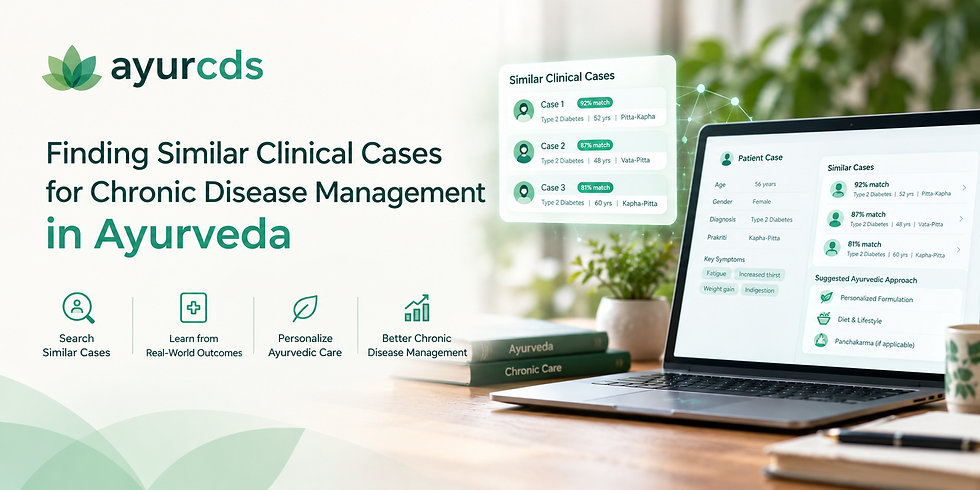
Search similar clinical cases
Explore documented treatment approaches
Review evidence-informed clinical resources
Access published case studies
Discover relevant research literature
Find disease-specific knowledge faster
Support clinical decision-making with organized information
Its purpose is not to recommend a single treatment but to make reliable clinical knowledge easier to find.
Who Can Benefit from Clinical Reference Apps?
Clinical reference software is valuable for:
BAMS practitioners
MD (Ayurveda) physicians
Panchakarma specialists
Ayurveda hospitals
Private clinics
Integrative medicine practitioners
Postgraduate students
Researchers
Teaching institutions
Whether you are a newly graduated doctor or have decades of experience, quick access to reliable clinical information improves efficiency and supports informed decision-making.
The Future of Ayurveda Is Knowledge-Driven
Healthcare is changing rapidly.
Patients expect informed answers.
Research continues to grow.
Clinical evidence is expanding.
Doctors are expected to make better decisions in less time than ever before.
Those who can efficiently access reliable knowledge will be better equipped to provide high-quality patient care while continuing to learn throughout their careers.
Clinical reference apps are becoming an essential part of this transformation.
Frequently Asked Questions
What is a clinical reference app in Ayurveda?
A clinical reference app helps Ayurvedic doctors quickly access organized clinical knowledge such as case studies, treatment approaches, research literature, and evidence-informed resources during clinical practice.
Does a clinical reference app replace clinical judgment?
No. These apps are designed to support physicians by providing relevant information. Final diagnosis and treatment decisions always remain the responsibility of the doctor.
Is AyurCDS a clinic management software?
No. AyurCDS is a Clinical Decision Support System focused on clinical knowledge retrieval, evidence-informed decision support, and searchable clinical information rather than appointments or billing.
Why are clinical reference apps becoming important?
As Ayurvedic literature, research, and clinical knowledge continue to grow, doctors need efficient ways to access relevant information without spending valuable consultation time searching through multiple sources.
Final Thoughts
The essence of Ayurveda has always been thoughtful, individualized care. What has changed is the amount of information available to support that care.
Modern practitioners no longer rely solely on memory or a shelf full of books. They work in an environment where clinical knowledge is expanding rapidly, patient expectations are evolving, and time is increasingly limited.
Clinical reference apps help bridge this gap by making trustworthy knowledge available when it is needed most.
AyurCDS embraces this philosophy. By organizing clinical cases, research, treatment approaches, and evidence-informed resources into a searchable platform, it supports Ayurvedic doctors in making faster, better-informed clinical decisions—while preserving the personalized and holistic approach that defines Ayurveda.


Comments