
AI for Ayurveda Doctors: How Artificial Intelligence can Empower Practitioners


For centuries, an Ayurvedic doctor's expertise has come from years of clinical experience, deep textual study, and sharpened intuition. Today, a new set of tools is joining the Vaidya's toolkit—not to replace that hard-earned skill, but to extend it. AI for Ayurveda doctors is emerging as a practical support system that helps practitioners diagnose faster, manage patients more efficiently, and back up traditional treatments with modern data.
This post is written specifically for practicing Ayurvedic doctors, clinic owners, and students exploring how AI fits into real clinical practice—not as hype, but as a working tool.
Why Ayurveda Doctors Should Pay Attention to AI
Modern Ayurvedic practice faces real operational pressure:
High patient volumes with limited consultation time
Manual record-keeping that makes tracking patient history difficult
Younger patients expecting digital convenience (bookings, follow-ups, reminders)
Increasing demand for scientific validation of treatments protocols
Competition from allopathic and integrative medicine clinics offering tech-enabled care
AI doesn't replace clinical judgment—but it can address these operational and research gaps directly.
Practical AI Tools and Use Cases for Ayurveda Doctors
1. AI-Assisted Patient Intake and History Taking
Instead of spending the first 10-15 minutes of every consultation gathering history, AI-powered intake forms can pre-collect symptoms, lifestyle habits, sleep patterns, and previous treatments before the patient even walks in—giving doctors a structured summary to review instantly.
2. Digital Prakriti and Vikriti Assessment Support
AI-based assessment tools can generate a preliminary dosha and imbalance profile using patient questionnaires, freeing up consultation time for deeper diagnostic conversation and treatment planning rather than repetitive baseline assessment.
3. Clinical Decision Support Systems
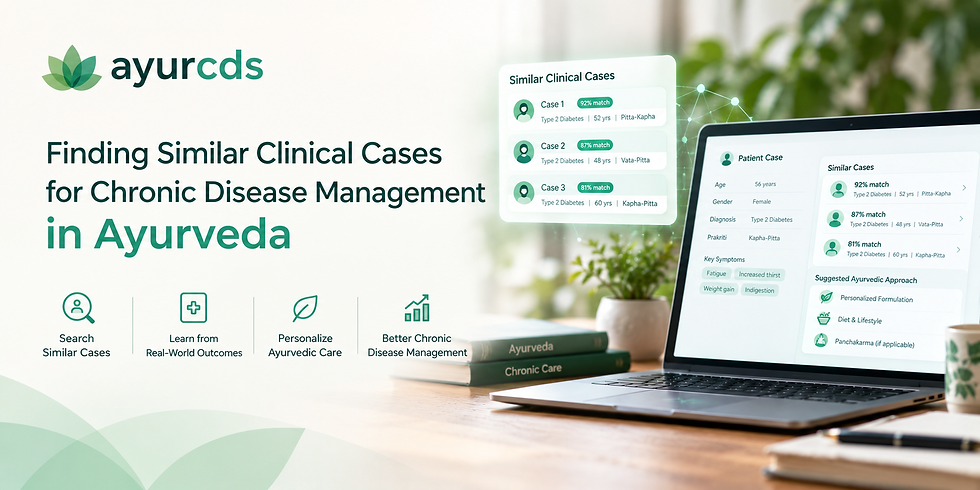
Some AI platforms are being trained on classical texts (Charaka Samhita, Sushruta Samhita) and treatment protocols to suggest possible herb combinations or Panchakarma therapies based on a patient's profile—functioning like a second opinion a doctor can accept, modify, or override.
4. Automated Patient Record Management
AI-powered clinic management software can digitize and organize patient histories, treatment timelines, and follow-up schedules, making it far easier to track long-term patient progress across multiple visits—something paper records struggle with.
5. Herb-Drug Interaction Checking
As more patients combine Ayurvedic treatment with allopathic medication, AI tools can flag potential interactions between herbs and pharmaceuticals, helping doctors make safer treatment decisions for patients managing chronic conditions.
6. Research and Evidence Backing
AI-driven literature analysis tools can quickly pull relevant clinical studies or trial data on specific herbs or formulations, helping doctors respond to increasingly research-savvy patients with evidence-backed explanations.
7. AI-Powered Patient Communication
Chatbots and automated follow-up systems can handle routine patient questions (dosage reminders, diet clarifications, appointment scheduling), reducing administrative load so doctors can focus on complex cases.
Benefits for Ayurveda Doctors Specifically
Benefit | Impact on Practice |
Faster intake and assessment | More consultation time for actual diagnosis and treatment |
Structured patient data | Easier long-term tracking and pattern recognition across visits |
Second-opinion decision support | Backup for complex or unusual cases |
Automated admin tasks | Reduced non-clinical workload |
Research access | Stronger, evidence-backed patient conversations |
Interaction checking | Improved patient safety in integrative care settings |
Addressing Common Concerns
"Will AI replace my clinical judgment?"
No. Every AI tool discussed here is designed to support—not replace—a doctor's decision-making. Final diagnosis, treatment customization, and the human relationship with patients remain firmly in the practitioner's hands.
"Is AI-generated advice accurate to classical Ayurveda?" This depends entirely on the training data. Doctors should vet any AI tool by checking whether it's built on verified classical texts and peer-reviewed research, not generic wellness content scraped from the internet.
"Do I need technical skills to use these tools?"
Most clinical AI tools for Ayurveda are designed with simple interfaces for non-technical users—similar to using any patient management software, not a coding platform.
How to Start Integrating AI Into Your Practice
Start small Begin with a digital patient intake or record-management tool before adopting more complex diagnostic support systems
Vet the source Choose platforms that clearly state their training sources (classical texts, clinical trials, practitioner input)
Use it as a second opinion Treat AI suggestions as a starting point for your own clinical reasoning, not a final answer
Train your staff Ensure your clinic team understands how to input data correctly, since AI output quality depends on data quality
Gather patient feedback
Track whether AI-assisted tools are actually improving patient experience and outcomes in your specific practice
Frequently Asked Questions (FAQs)
Q1: What is the biggest advantage of AI for Ayurveda doctors?
Time savings on administrative and preliminary assessment tasks, allowing more focus on complex clinical decision-making and patient relationships.
Q2: Can AI help with Panchakarma treatment planning?
Some advanced clinical decision-support tools like AyurCDS can suggest Panchakarma protocols based on patient profiles, but the final therapy plan should always be customized and supervised by the treating physician.
Q3: Are there AI tools specifically for Ayurvedic hospitals or larger clinics?
Yes, several health-tech platforms now offer AI-integrated hospital management systems tailored for Ayurvedic hospitals, covering patient records, billing, and treatment tracking in one system.
Q4: How do I know if an AI tool is trustworthy for clinical use?
Look for transparency about training data sources, peer-reviewed backing, and reviews or case studies from other verified practitioners before adopting any tool in your practice.


Comments