
Why Ayurveda Needs Structured Knowledge: The Role of Digital Platforms in Clinical Decision Making

Updated: Sep 13

Ayurveda's Greatest Strength Is Its Knowledge—But Much of It Remains Disconnected
Ayurveda is one of the world's oldest and most comprehensive systems of medicine. Its clinical wisdom is preserved in classical texts such as the Charaka Samhita, Sushruta Samhita, Ashtanga Hridaya, regional manuscripts, pharmacopoeias, research publications, and the invaluable experience of generations of practitioners.
Yet despite this richness, much of Ayurveda's knowledge remains fragmented.
A physician searching for information on a single condition may need to consult multiple texts, research papers, personal notes, and digital resources before arriving at a clinical decision. Valuable case experiences often remain confined to individual clinics, while institutional knowledge is rarely organized in a reusable format.
As Ayurveda embraces digital healthcare, artificial intelligence (AI), and evidence-informed practice, organizing this knowledge into structured digital systems is no longer optional—it is essential.
This is where Ayurveda Knowledge Platforms, Clinical Case Repositories, and Clinical Decision Support Systems (CDSS) become transformative.
The Challenge: Ayurveda Has Information Everywhere, But Knowledge Nowhere
Today's Ayurvedic ecosystem generates enormous amounts of information:
Classical literature
Hospital records
Electronic Medical Records (EMRs)
Published research
Case reports
Clinical observations
Drug formularies
Panchakarma protocols
Diagnostic methods
Educational material
Unfortunately, most of these resources exist in isolation.
Knowledge stored as books, PDFs, spreadsheets, handwritten notes, or disconnected software cannot easily be searched, analyzed, or reused. As a result:
Practitioners spend significant time searching for information.
Students struggle to connect concepts across multiple texts.
Researchers repeatedly collect similar data.
Hospitals cannot effectively compare treatment outcomes.
Valuable clinical experience is lost over time.
Digital transformation should not simply convert paper records into electronic files. It should transform scattered information into connected, searchable clinical knowledge.
Why Ayurveda Needs a Dedicated Knowledge Platform
An Ayurveda Knowledge Platform goes far beyond a digital library.
It connects classical knowledge, modern research, formulations, herbs, clinical guidelines, educational content, and real-world practice into a unified ecosystem.
Instead of searching across multiple websites or books, practitioners can explore interconnected knowledge from a single platform.
A comprehensive knowledge platform can include:
Classical Ayurvedic references
Clinical practice guidelines
Herb and formulation databases
Disease-specific knowledge
Panchakarma protocols
Research publications
Drug interactions
Evidence summaries
Educational resources
Clinical decision support
Case repositories
Such a platform enables practitioners to access the right information at the right time while preserving the depth and authenticity of classical Ayurveda.

The Importance of an Ayurveda Case Repository
One of the most underutilized assets in Ayurveda is its vast collection of clinical experiences.
Every day, thousands of practitioners successfully manage patients with individualized treatment approaches. However, these experiences often remain undocumented or inaccessible to the wider community.
An Ayurveda Case Repository is a structured digital collection of anonymized clinical cases that captures:
Patient presentation
Prakriti and Vikriti assessment
Diagnosis
Nidana and Samprapti
Treatment principles
Medicines prescribed
Panchakarma interventions
Lifestyle recommendations
Follow-up observations
Clinical outcomes
Supporting evidence
A well-designed case repository allows practitioners and researchers to learn from real-world clinical practice, identify treatment patterns, compare outcomes, and generate new research questions.
It also contributes to evidence generation while preserving the individualized nature of Ayurvedic treatment.
Clinical Decision Support: Helping Practitioners Make Better Decisions
A Clinical Decision Support System (CDSS) is not designed to replace the Ayurvedic physician. Instead, it serves as an intelligent assistant that brings relevant knowledge into the clinical workflow.
For example, when a practitioner evaluates a patient with symptoms suggestive of Amlapitta, the system may present:
Relevant classical references
Associated Dosha involvement
Common Nidana
Samprapti overview
Differential diagnoses
Suggested Chikitsa Siddhanta
Relevant formulations
Supporting herbs
Panchakarma options
Published research
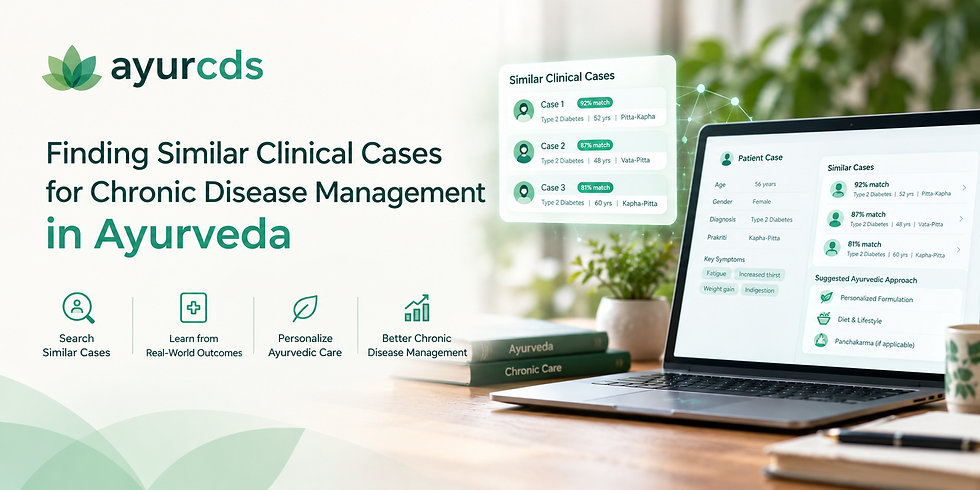
Similar clinical cases from the case repository
This enables faster access to relevant information while leaving all clinical decisions to the physician.
Connecting Knowledge, Cases, and Clinical Practice
The true power of digital Ayurveda lies in connecting three essential components:
A centralized repository of classical texts, formulations, herbs, diseases, research, and educational resources.
2. Case Repository
A structured database of anonymized clinical cases that captures treatment approaches and outcomes from real-world practice.
3. Clinical Decision Support
An intelligent layer that retrieves relevant knowledge and comparable cases to assist practitioners during patient consultations.
Together, these components create a learning healthcare ecosystem where every consultation contributes to future knowledge.
Benefits of Structured Knowledge for Ayurveda
Faster Clinical Decisions
Instant access to classical references, evidence, formulations, and previous clinical cases reduces the time spent searching across multiple resources.
Better Research
Structured datasets and case repositories make observational studies, multicenter collaborations, and evidence generation more efficient.
Standardized Documentation
Hospitals and institutions can adopt consistent terminology, improving interoperability and data quality.
Enhanced Education
Students can understand relationships between diseases, doshas, formulations, and clinical outcomes through interactive learning rather than isolated reading.
AI-Ready Ayurveda
Artificial intelligence relies on structured, high-quality data. Knowledge platforms and case repositories provide the foundation for future AI applications, including intelligent search, predictive analytics, literature summarization, and decision support.
Preservation of Clinical Wisdom
Documenting real-world cases ensures that valuable practitioner experience is preserved for future generations instead of remaining locked within individual clinics.

AyurCDS: Building the Digital Knowledge Infrastructure for Ayurveda
AyurCDS is envisioned as more than a clinical software solution. It is being developed as a comprehensive Ayurveda Knowledge Platform that integrates structured clinical knowledge, a growing Ayurveda Case Repository, and intelligent Clinical Decision Support into a unified ecosystem.
The platform aims to connect:
Classical Ayurvedic literature
Diseases and diagnostic concepts
Herbs and formulations
Panchakarma therapies
Clinical practice guidelines
Research publications
Real-world case records
Clinical decision support tools
By organizing these resources into an interconnected knowledge network, AyurCDS enables practitioners, researchers, educators, and healthcare institutions to access reliable information more efficiently, support evidence-informed practice, and contribute to the long-term digital preservation of Ayurvedic knowledge.
The Future of Ayurveda Is Connected Knowledge
The future of Ayurveda will not be defined solely by digitizing patient records. It will be shaped by building intelligent systems that connect knowledge, clinical experience, research, and education.
Knowledge platforms will preserve centuries of classical wisdom.
Case repositories will transform everyday clinical experience into reusable evidence.
Clinical Decision Support Systems will deliver the right knowledge at the point of care.
Together, these digital capabilities can strengthen clinical practice, accelerate research, improve education, and prepare Ayurveda for an AI-enabled future while remaining rooted in its traditional principles.
Conclusion
Ayurveda possesses an extraordinary body of medical knowledge, but much of it remains dispersed across texts, institutions, and individual practitioners. Transforming this information into structured, interconnected knowledge is essential for improving patient care, advancing research, preserving clinical wisdom, and enabling responsible AI innovation.
An integrated ecosystem combining an Ayurveda Knowledge Platform, a structured Clinical Case Repository, and intelligent Clinical Decision Support can bridge the gap between ancient wisdom and modern digital healthcare.
AyurCDS is committed to building this foundation—helping practitioners access trusted knowledge, learn from real-world clinical cases, and make informed decisions while honoring the principles of authentic Ayurveda.
Frequently Asked Questions
What is an Ayurveda Knowledge Platform?
An Ayurveda Knowledge Platform is a centralized digital system that organizes classical texts, diseases, herbs, formulations, research, educational resources, and clinical knowledge into a searchable, interconnected repository.
What is an Ayurveda Case Repository?
An Ayurveda Case Repository is a structured database of anonymized clinical cases that documents patient presentations, diagnoses, treatments, follow-up, and outcomes to support learning, research, and evidence generation.
How does Clinical Decision Support benefit Ayurveda practitioners?
Clinical Decision Support provides timely access to classical references, formulations, research evidence, and comparable clinical cases, enabling practitioners to make faster and better-informed decisions while retaining full clinical autonomy.
Why is structured knowledge important for AI in Ayurveda?
AI systems require structured, standardized, and high-quality data. Organizing Ayurvedic knowledge and clinical cases into digital repositories enables future applications such as intelligent search, outcome analysis, predictive insights, and evidence-based clinical support.
How does AyurCDS contribute to digital Ayurveda?
AyurCDS combines a structured knowledge platform, a clinical case repository, and clinical decision support capabilities to help practitioners, researchers, educators, and institutions preserve, access, and apply Ayurvedic knowledge more effectively.


Comments