
Clinically Meaningful Evidence Based Practice in Ayurveda : Why It Matters Now

Updated: Aug 9
Modern clinicians face a common challenge: integrating a vast, complex body of classical knowledge with today’s fast-paced clinical workflows. With the rise of extensive diagnostic tests and digital tools — including Clinical Decision Support Systems (CDS) — there’s an exciting opportunity to bridge ancient wisdom and evidence-based practice. However, to make meaningful improvements in patient care, these tools must be grounded in clinically meaningful evidence — not just fast algorithms.

What Is Clinically Meaningful Evidence in Healthcare?
In modern medicine, clinically meaningful evidence is more than a summary of research. It’s evidence that:
Helps practitioners make safe and effective decisions
Aligns with patient needs and outcomes.
Clinical evidence isn’t just about the newest study or fastest AI summary. It requires critical interpretation: understanding study strength, relevance to a specific patient, and real-world applicability. These principles are just as vital in Ayurveda especially when adapting classical texts, case patterns, and emerging clinical data to contemporary practice.
AI: A Powerful Tool — But Not a Replacement for Expertise
Artificial intelligence has transformed clinical workflows by rapidly processing vast amounts of information, highlighting relevant patterns, and summarizing literature. In mainstream healthcare, AI tools can quickly identify pertinent studies or guidelines, making it easier for clinicians to stay updated.
But speed isn’t enough. AI systems can only reorganize or summarize data they have access to. They often cannot evaluate:
study quality or bias,
relevance to an individual patient
cultural and contextual factors
holistic modalities such as prakriti, srotas, and dosha interactions.
In Ayurveda, clinical judgment — founded on experience, patient context, and traditional principles — remains essential. AI and CDS tools should support this judgment and act as augumentative tool
How Evidence and Clinical Judgment Work Together
To translate evidence into meaningful decisions in Ayurveda, clinicians must:
Define clear clinical questions — What problem are we solving for this patient?
Evaluate all available evidence — from classical texts, case series, observational studies, and real-world practice data.
Understand evidence quality — not all sources are created equal.
Integrate patient values and context — including lifestyle, prakriti, and individual preferences.
Apply clinical experience — synthesizing all the above to form a tailored treatment plan.
This careful process ensures that decisions are not only safe and effective but also person-centered — one of the core tenets of Ayurveda.
Why Ayurveda Needs Strong Evidence Foundations
Ayurvedic practice is rich and complex. Every patient presents a unique combination of dosha imbalance, life context, and disease expression. Traditional theory provides a framework — but modern clinical application requires evidence that
Demonstrates real-world effectiveness,
Validates diagnostic patterns and treatment outcomes,
Helps clinicians adapt classical knowledge to contemporary clinical settings,
Supports communication with patients, institutions, and regulatory bodies.
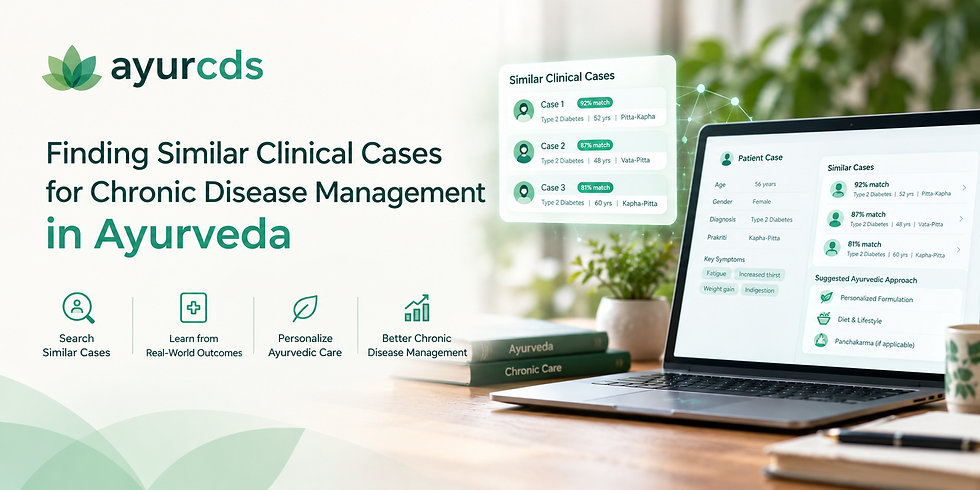
Here, CDS platforms like AyurCDS play a pivotal role. By integrating curated, clinically relevant evidence with data driven support tools, AyurCDS can help clinicians:
Improve diagnostic accuracy
Access relevant classical and modern evidence quickly
Navigate complex clinical decisions with confidence
Personalize care more consistently across different practice settings.
This fusion of reliable evidence and digital support enhances both clinician capacity and patient outcomes — without sacrificing the depth or tradition of Ayurveda.
AI + Evidence + Clinical Expertise: A Balanced Future
AI and clinical decision support systems are reshaping how clinicians interact with clinical information. But trustworthy support depends on:
Evidence evaluated by experts, not just generated by algorithms,
Clinician experience and judgment,
Patient-centered values and real-world applicability,
Transparent, traceable, and robust evidence sources.
In Ayurveda, this means building CDS tools that respect the traditions of classical knowledge and help practitioners apply it with precision in modern practice.
Conclusion
Clinically meaningful evidence — carefully interpreted and integrated with AI-enhanced tools and softwares — offers a powerful path forward for Ayurveda. By aligning tradition with data, clinical expertise with technology, and patient values with evidence, Ayurvedic clinicians can deliver care that is both timeless and scientifically sound.
AyurCDS represents this evolution: empowering clinicians with the right knowledge at the right time, without compromising the principles that make Ayurveda unique.


Comments