
Using AyurCDS as an Education and Research Resource in Ayurveda
- srikanthragothaman
- Dec 25, 2025
- 3 min read

Updated: Dec 30, 2025
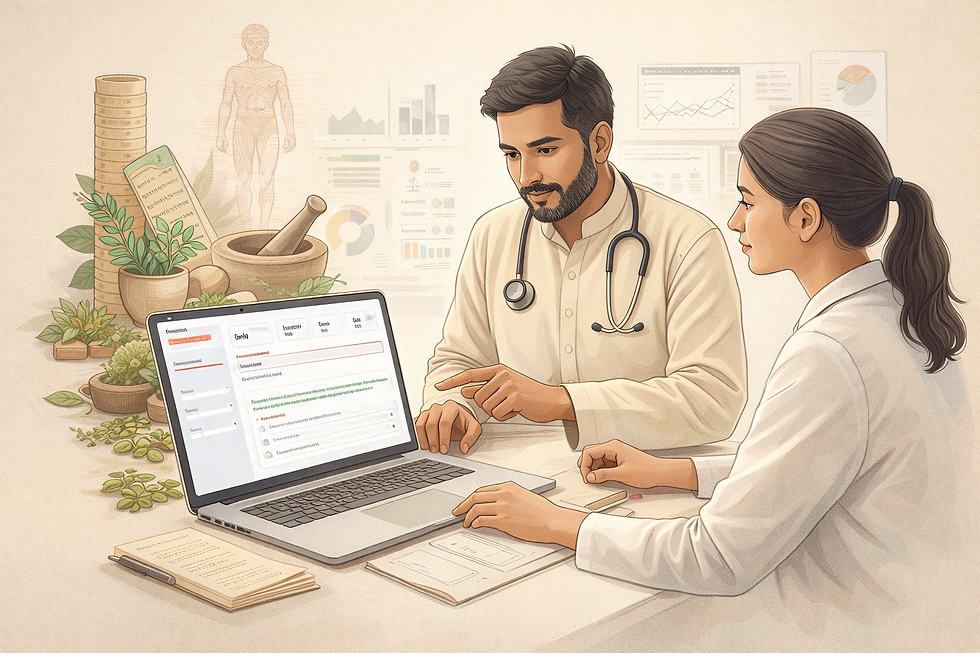
Ayurveda education and research have traditionally relied on classical texts, teacher–student transmission, and isolated clinical case records. While these foundations remain essential, modern academic and research environments increasingly require structured data, reproducibility, and outcome-based analysis.
AyurCDS (Ayurveda Clinical Decision Support) is emerging as a digital resource that supports education and research in Ayurveda, not by altering classical principles, but by systematically organizing real-world clinical knowledge generated through everyday practice.
This article explores how AyurCDS can be effectively used as an educational and research-support platform within Ayurvedic institutions and clinical settings.
Bridging the Gap Between Classical Knowledge and Clinical Application
One of the key challenges in Ayurveda education is translating theoretical concepts into practical clinical reasoning.
AyurCDS helps bridge this gap by:
Structuring clinical documentation around classical frameworks
Linking Prakriti, Vikriti, Dosha, Samprapti, and Chikitsa logically
Making implicit clinical reasoning explicit and reviewable
For students and trainees, this provides a clear view of how classical principles are applied in real patients, rather than remaining abstract concepts.
Supporting Case-Based Learning in Ayurveda Education
Case-based learning is central to Ayurvedic pedagogy, but traditional case records are often:
Inconsistent
Incomplete
Difficult to compare or analyze
AyurCDS enables:
Standardized Ayurvedic case documentation
Longitudinal tracking of patient progress
Comparison of similar cases across conditions or Dosha profiles
Educational value:
Students learn clinical reasoning, not just outcomes
Teachers can demonstrate treatment rationale step by step
Case discussions become structured and evidence-informed
Enhancing Postgraduate and Clinical Training Programs
For postgraduate education and internships, exposure to large volumes of structured clinical data is essential.
AyurCDS supports:
Systematic observation of OPD and IPD cases
Reflection on treatment modifications over time
Identification of patterns in response and non-response
Supervised review of clinical decisions
This strengthens clinical confidence, analytical thinking, and accountability among trainees.
Facilitating Practice-Based Research in Ayurveda
Ayurvedic research has often struggled with:
Lack of standardized datasets
Difficulty in aggregating clinical observations
Limited reproducibility
AyurCDS addresses these challenges by enabling:
Structured, research-ready clinical data capture
Anonymized data extraction for analysis
Development of observational studies and case series
Longitudinal outcome evaluation
This allows researchers to generate practice-based evidence grounded in real clinical settings.
Supporting Observational Studies and Case Series
AyurCDS is particularly suited for:
Retrospective and prospective observational studies
Single- and multi-center case series
Outcome-based clinical audits
By maintaining consistency in documentation, the platform helps ensure:
Data quality
Methodological transparency
Better alignment with academic and publication standards
Enabling Institutional Research and Academic Output
For Ayurvedic colleges, hospitals, and research centers, AyurCDS can function as a centralized academic resource.
Institutions can use it to:
Build internal clinical databases
Support faculty and student research projects
Standardize case documentation across departments
Facilitate ethics-approved data access workflows
This supports sustained academic output without disrupting routine clinical work.
Strengthening Evidence-Based Ayurveda Education
AyurCDS contributes to evidence-based education by:
Making clinical outcomes visible and measurable
Encouraging reflective practice
Helping learners understand variability in patient response
Supporting critical evaluation of treatment approaches
Students learn that evidence in Ayurveda emerges from systematic observation and reasoning, consistent with classical traditions.
Supporting Interdisciplinary and Integrative Research
Digitally structured Ayurvedic data also enables:
Collaboration with biostatisticians and data scientists
Integration with public health and epidemiological studies
Dialogue with modern medical research frameworks
This positions Ayurveda as a knowledge system capable of structured inquiry and academic engagement.
Ethical and Responsible Use in Education and Research
AyurCDS supports responsible academic use by enabling:
Patient data anonymization
Controlled access for research purposes
Compliance with ethical and institutional guidelines
This is essential for maintaining trust and academic integrity.
Benefits of Using AyurCDS as an Academic Resource
Area | Benefit |
Undergraduate education | Clear clinical reasoning examples |
Postgraduate training | Structured exposure to real cases |
Faculty research | Research-ready datasets |
Institutional studies | Standardized data across departments |
Publications | Improved documentation quality |
Evidence building | Practice-based, real-world evidence |
Conclusion
AyurCDS extends beyond being a clinical support platform—it serves as a living educational and research resource for Ayurveda.
By structuring real-world clinical practice into analyzable, teachable, and research-ready data, AyurCDS supports:
Stronger Ayurvedic education
Meaningful practice-based research
Improved academic credibility
Preservation of classical reasoning in modern contexts
When used thoughtfully, AyurCDS helps ensure that Ayurveda’s future growth is grounded in both tradition and evidence.



Comments