
Why Ayurveda Doctors Are Turning to Digital Doctor Assistant Tools

Updated: Aug 9

Ayurveda doctors are practicing in an era of rapid change.
Patient expectations are rising.Clinical cases are becoming more complex.Doctors are expected to explain, justify, document, and decide—often within minutes.
At the same time, Ayurveda education and daily practice still rely heavily on:
Memory-based recall
Classical texts that are not OPD-friendly
Fragmented references across books, PDFs, and notes
Search engines that provide information, but not clinical clarity
This widening gap between knowledge availability and clinical usability is pushing many Ayurveda doctors to look for something new.
Not automation.Not shortcuts.But better decision support.
This is where Doctor Assistant Tools are beginning to play a meaningful role in modern Ayurveda practice.
What Does “Doctor Assistant Tool” Really Mean?
A doctor assistant tool is often misunderstood.
It is not a robot doctor. It does not replace clinical experience.And it does not tell doctors what to prescribe.
Instead, a doctor assistant tool functions as a clinical thinking companion.
In modern allopathic medicine, tools like UpToDate, DynaMed, and BMJ Best Practice exist to:
Help doctors think systematically
Reduce uncertainty during decision-making
Provide context-aware clinical information
Support evidence-based practice at the point of care
Ayurveda, despite its depth and sophistication, has historically lacked such structured clinical support tools.
AyurCDS was created to fill this exact gap.
AyurCDS: A Doctor Assistant Tool Designed for Ayurveda Thinking
AyurCDS is not a general health platform or an AI chatbot.
It is intentionally built around how Ayurveda doctors think during real consultations.
Instead of keyword-based searching, it focuses on:
Clinical reasoning pathways
Symptom–Dosha–Vyadhi relationships
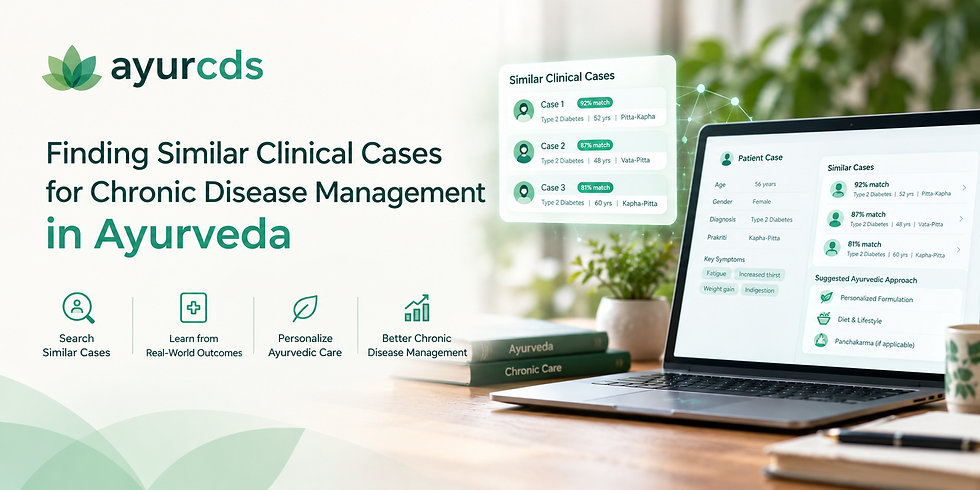
Pattern recognition across cases
Decision support rooted in Ayurvedic logic
The goal is not to overwhelm doctors with information, but to support clinical clarity at the moment it is needed most.
In practice, AyurCDS behaves like a quiet, reliable assistant during OPD—available when needed, invisible when not.
Bridging the Gap Between Classical Knowledge and Clinical Reality
One of the biggest challenges in Ayurveda practice is not lack of knowledge.
It is translation.
Doctors are trained in:
Shlokas
Samhitas
Theoretical frameworks
But daily practice demands:
Quick interpretation
Context-based application
Handling mixed presentations and chronic conditions
Explaining decisions to patients in simple terms
AyurCDS helps bridge this gap by:
Structuring classical concepts for clinical use
Highlighting clinically relevant insights
Connecting theory with real-world patterns
Supporting Evidence-Based Ayurveda, not just citation-based Ayurveda
This allows doctors to remain faithful to tradition while practicing with modern clinical confidence.
Evidence-Based Ayurveda, Without Losing Ayurveda
Evidence-based practice in Ayurveda is often misunderstood as “Westernization.”
AyurCDS takes a different approach.
It focuses on:
Clinically meaningful evidence
Case-oriented understanding
Practice-based insights
Patterns observed across real patients
Rather than forcing Ayurveda into a biomedical framework, AyurCDS supports Ayurvedic evidence on its own terms—while still meeting modern expectations of rigor and consistency.
This is particularly valuable for:
Academic clinicians
Teaching hospitals
Doctors involved in research or publications
Practitioners seeking credibility in integrative settings
Designed for Doctors — Not for Marketing or Mass Wellness
AyurCDS is deliberately not a patient-facing wellness app.
It avoids:
Simplified “health tips”
Generic AI advice
Marketing-driven content
Overpromising outcomes
Instead, it is built for:
BAMS and MD (Ay) doctors
Clinical educators
Postgraduate students
Serious practitioners focused on long-term practice quality
Every design decision reflects a single principle:
Support the doctor’s judgment, not replace it.
Reducing Cognitive Load in Busy OPDs
Clinical decision-making is mentally demanding.
Doctors juggle:
Multiple symptoms
Chronic histories
Patient expectations
Time pressure
Responsibility for outcomes
AyurCDS functions as a cognitive support system, helping doctors:
Recall relevant diagnostic frameworks faster
Cross-check their reasoning
Avoid tunnel vision
Maintain consistency across cases
Reflect more deeply on complex presentations
This does not make doctors dependent on software—it makes them more confident and deliberate.
Why Google, PubMed, or ChatGPT Are Not Enough for Doctors
Many doctors already use digital tools—but often out of necessity, not satisfaction.
Tool | Why It Falls Short in Clinical Practice |
Google Search | Unstructured, noisy, non-clinical |
PubMed | Research-heavy, not OPD-friendly |
ChatGPT | Generic, unverifiable, lacks Ayurvedic reasoning |
AyurCDS | Structured, clinical, Ayurveda-specific |
AyurCDS is best understood as an “UpToDate-style assistant for Ayurveda”—designed specifically for Indian clinical realities and Ayurvedic decision-making.
A Quiet Shift in Ayurveda Practice
Across healthcare, there is a clear shift toward:
Clinical decision support
Structured medical knowledge
Documentation and consistency
Evidence-informed care
Ayurveda is no exception.
Doctors who adopt tools like AyurCDS are not abandoning tradition—they are strengthening it, ensuring Ayurveda remains:
Clinically credible
Academically strong
Professionally future-ready
The Bigger Picture: Future-Ready Ayurveda Doctors
AyurCDS is more than software.
It represents a broader movement toward:
Thoughtful, reflective Ayurveda practice
Stronger clinical reasoning
Better teaching and mentorship
Increased confidence in complex cases
A modern identity for Ayurveda doctors
In a healthcare world increasingly shaped by decision support tools, AyurCDS ensures Ayurveda doctors move forward—without losing their roots.


Comments